There is a number that the Federal Reserve, credit card issuers, mortgage lenders, and every consumer credit model in the United States cannot see. It is growing at 8.5% a year. It sits entirely outside traditional credit bureau reporting for a large share of its transactions. And it is being used - right now - by people who are simultaneously carrying credit card debt, auto loans, and student loans that those other creditors also cannot see in full.
That number is the outstanding balance of Buy Now, Pay Later loans. The BNPL market reached $122 billion in US transaction volume in 2025, used by over 86 million Americans. The industry is sold to consumers as financial freedom - split any purchase into four easy payments, zero interest, approved in seconds. What it actually represents, increasingly, is a shadow credit layer that systematically blinds the financial system to how stretched the American consumer really is.
This analysis draws on data from Forbes, the Federal Reserve, LendingTree, Motley Fool, Consumer Edge, Bank of America Global Research, and CB Insights research to give you an honest picture of what BNPL is doing to the economy - and what the investment implications are on both sides of the ledger.
The Hidden Debt Layer
Start with the consumer debt picture most investors reference. The chart below - published by the New York Federal Reserve - shows the full stack of non-housing consumer debt in the United States: credit cards approaching $1.23 trillion, auto loans, student debt, and the residual "other" category that has grown steadily since 2004. It is a useful picture of consumer leverage. It is also incomplete in a way that wasn't true five years ago.
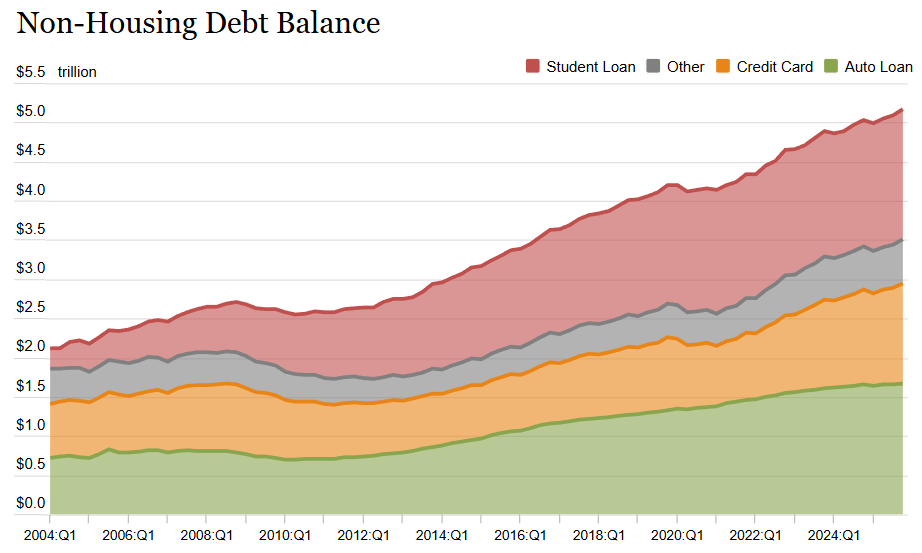
BNPL balances are largely absent from this picture. Credit bureaus have historically received little or no reporting from the major BNPL providers. The three major US bureaus - Equifax, Experian, and TransUnion - have only recently begun receiving data from some providers, and even now the coverage is incomplete. CB Insights research estimates that total consumer debt figures are understated by at least 1% - approximately $40 billion - with BNPL balances growing at 8.5% annually. That gap is only widening.
"BNPL is not simply another credit product competing with Visa and Mastercard. It is a parallel credit system with no shared information layer. Affirm does not know what you owe to Klarna. Klarna does not know what you owe to Afterpay. No single institution - not the banks, not the bureaus, not the regulators - can see the full picture. And consumers themselves increasingly cannot either."
This creates a dynamic that echoes, in structure if not yet in scale, the pre-2008 mortgage market: a product being extended to consumers whose true total obligations are systematically obscured from each individual lender. Some BNPL firms argue that reporting would harm their customers' credit scores - that the bureaus' models are calibrated for conventional revolving credit and overpenalize the frequent short-term loans that BNPL involves. There is some validity to that concern. But it is also, conveniently, an argument that protects the business model by reducing competitive visibility into borrower quality.
Who Is Actually Using This - And How Often
The narrative that BNPL is primarily a tool of the financially desperate - young consumers who can't qualify for credit cards, subprime borrowers stretching for purchases they can't afford - is partially true but significantly incomplete. The data reveals something more systemic and, from a credit risk standpoint, more concerning.
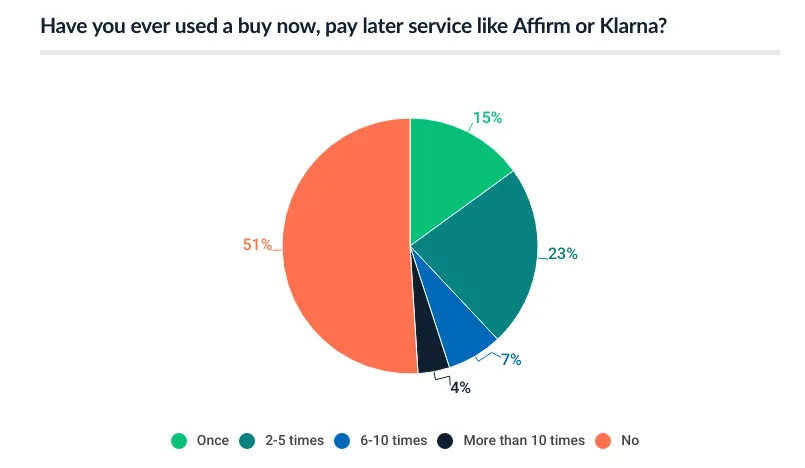
Almost half of Americans have used BNPL, with roughly 10% categorized as power users - those with six or more active loan relationships. A Harris Poll conducted in 2025 on behalf of NerdWallet found that 22% of consumers currently owe money to a BNPL provider, with 19% carrying multiple BNPL loans simultaneously across the prior twelve months. The Federal Reserve Bank in New York found 14% of adults used BNPL in 2022; Philadelphia Fed research found 20% by 2023. Usage is growing faster than the surveys can track it.
Critically, the consumer base is not confined to the financially marginal. As CB Insights research notes: when something turns sour in the credit system, it needs to affect the middle class to matter - see mortgages in the Great Financial Crisis. BNPL usage spans all income cohorts on similar trajectories, with a predictable spread where higher income shows slightly lower adoption rates, but all bands are growing. This is not a subprime problem. It is a structural credit system problem that happens to be most concentrated in lower-income cohorts.
The Global Context: America Is Behind the Curve
One detail that consistently surprises American readers: the United States is not where BNPL is most embedded in the consumer economy. That distinction belongs to Northern Europe, where the product has been normalised for over a decade - and where the downstream consequences of widespread adoption are now visible in ways that should give US market observers pause.
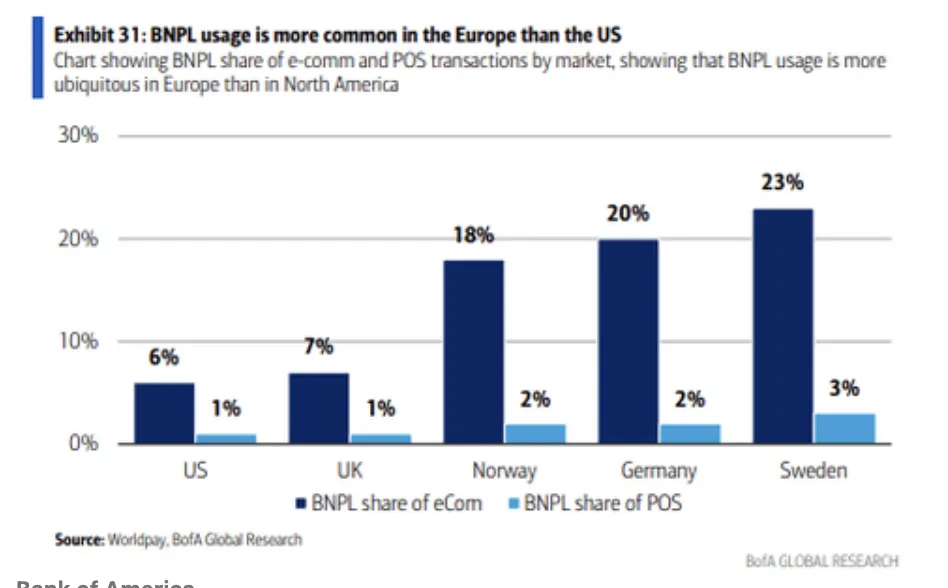
Sweden, where Klarna originated, has seen BNPL absorb 23% of e-commerce transactions. Germany sits at 20%. Norway at 18%. The United Kingdom, which shares more cultural and regulatory characteristics with the US, is at 7% and growing. The US, currently at 6-7.5% of e-commerce, is tracking the same adoption curve - roughly five to eight years behind Europe. Sweden's experience offers a preview: widespread use, rising consumer debt stress, and now increasing regulatory attention. The UK's Financial Conduct Authority has already moved to regulate BNPL. US regulatory structures are only beginning to engage with the same questions.
What Are They Actually Buying?
The composition of BNPL spending reveals something important about the underlying economic reality. If consumers were primarily using BNPL to finance aspirational purchases - luxury goods, electronics, holidays - the narrative of "convenience credit" would be more defensible. The actual spend mix tells a different story.
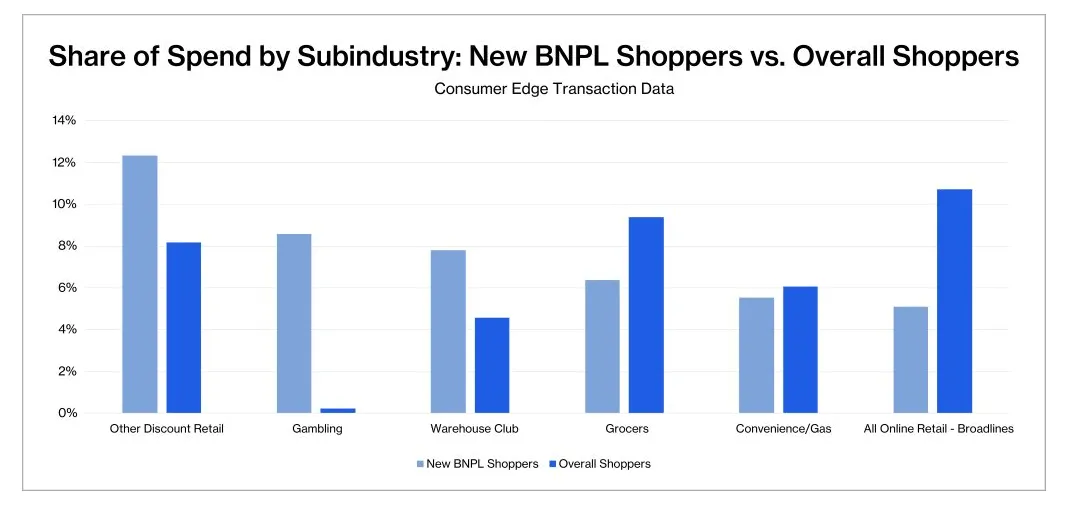
According to LendingTree data, a quarter of all BNPL spending goes to groceries, with food-related spending totalling approximately 54% of all BNPL transactions. Consumer Edge transaction data shows new BNPL shoppers dramatically over-indexing in discount retail (12% of spend vs 8% for overall shoppers) and warehouse clubs. Adobe estimates that the online value of BNPL loans during the Thanksgiving-to-Cyber Monday five-day window alone will top $20.2 billion - nearly 20% of the year's total - suggesting the product is deeply embedded in essential and seasonal spending cycles, not merely discretionary luxuries.
The gambling category is striking and deserves direct acknowledgement. BNPL shoppers spend a disproportionately large share at gambling platforms relative to the broader consumer population. This is not incidental - it reflects a consumer profile that is comfortable with high-frequency, high-impulsivity spending decisions, often financed with borrowed money. It also means that for a meaningful subset of BNPL users, the product is literally providing gambling liquidity. This is not the type of credit quality that builds sustainable repayment capacity.
The GDP Backstop Argument
There is a wholly valid counter-argument that BNPL for groceries means that people living paycheck-to-paycheck can go to the grocery store between pay cycles - when otherwise they might have to wait to get paid before doing so. This is a real benefit for households with volatile income. The same argument applies to credit cards for consumers who pay on time. The question is not whether BNPL provides value to some consumers - it clearly does. The question is whether the system-level risks created by opaque reporting are being adequately priced and regulated. Currently, the answer is no.
The Lost Track Problem
Here is a data point that should stop any analyst cold: no age cohort has below a 13% rate of having failed to keep track of all their BNPL payments. Not Gen Z. Not Baby Boomers. Not any demographic segment surveyed.
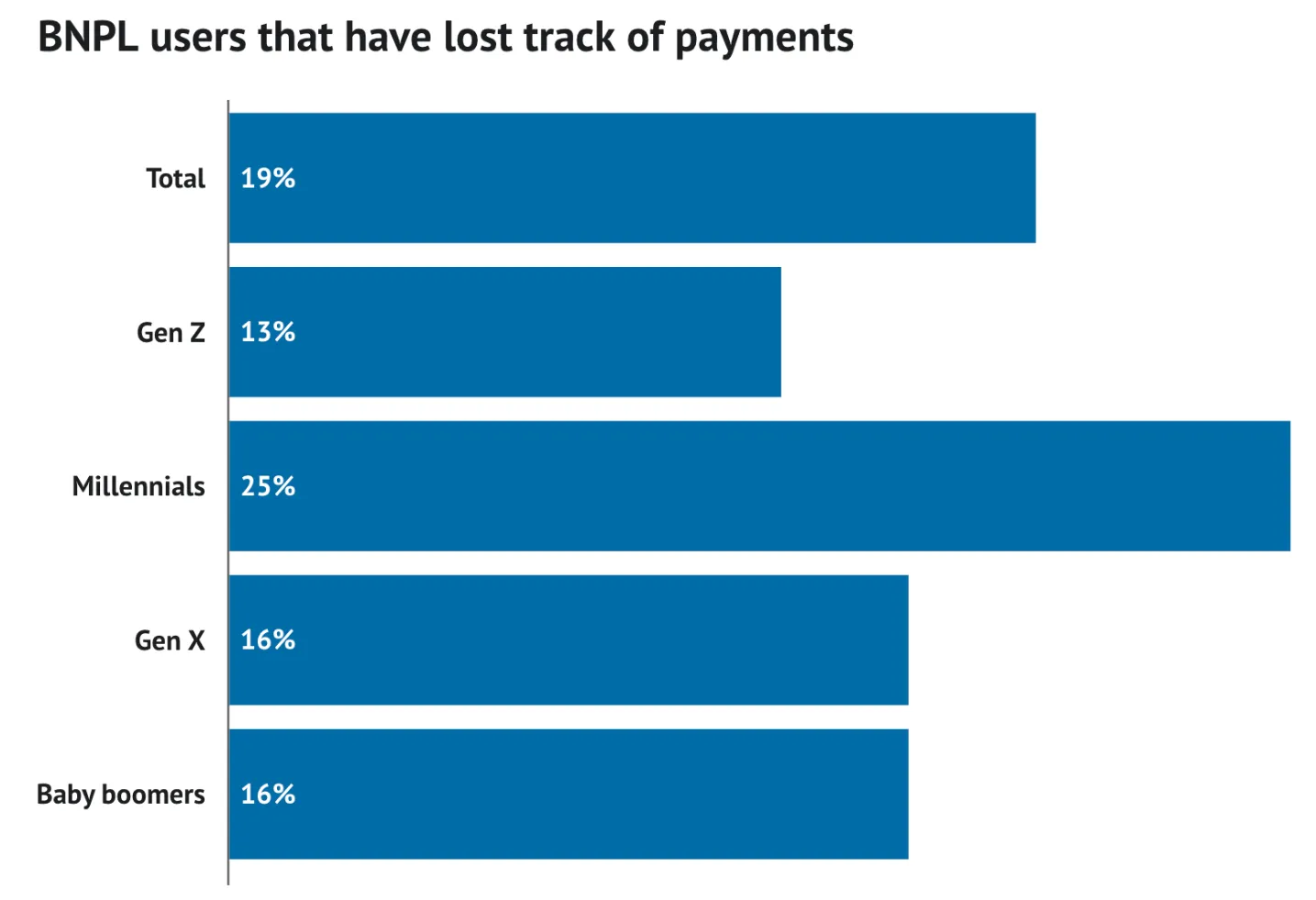
Overall, 19% of BNPL users cannot account for all their outstanding loans. Among Millennials - the cohort most associated with the product's mainstream adoption - that figure rises to 25%. A quarter of Millennial BNPL users do not know what they owe.
This is not a failure of financial literacy. It is an architectural failure of the product. A consumer who uses Affirm for electronics, Klarna for clothing, and Afterpay for travel is managing three separate loan schedules, three payment calendars, and three sets of terms - while none of the three providers can see the other two. The incentive for each provider is to approve the next transaction and collect the merchant fee. The incentive to understand total borrower obligations is structurally subordinated to volume growth. This is how credit systems develop fragility at the margin.
The Delinquency Picture
When a financial product has a 19% rate of users losing track of their obligations, it is not surprising that late payment rates are elevated. What is surprising is how elevated they are - and that the most financially stretched cohort is not necessarily where the headline data suggests.
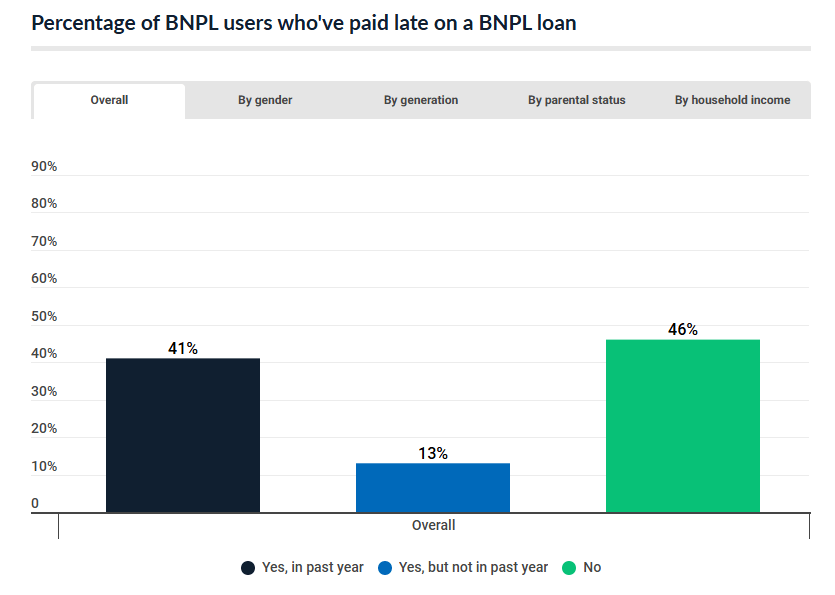
LendingTree's April 2025 survey found that 41% of all BNPL borrowers had made late payments in the prior year. Among Gen Z consumers, LendingTree found a rate of 57%; among Millennials, 49%. The Federal Reserve Board, in its own separate analysis, reported BNPL late payments at 24% - a figure that already alarmed Federal Reserve Governor Michael Barr enough to label BNPL a "debt trap" in remarks at a July Fed conference on financial inclusion. "Delinquency rates have gone up to 25%," Barr said. "It's a growing area of concern and one we should all be paying attention to."
One finding from the CB Insights analysis is worth highlighting separately because it cuts against the simple narrative of BNPL as a subprime problem: high-income borrowers have a higher late payment rate relative to other income bands in some cohorts. This counterintuitive finding suggests that the behavioral dynamics of BNPL - the frictionless approval, the "buy now" impulse, the fragmented tracking problem - affect affluent consumers as well as financially constrained ones. If late payments were purely a function of affordability stress, you would expect a monotonic relationship between income and payment performance. The data does not consistently show that.
Federal Reserve on Consumer Vulnerability
"Adults who report lower overall financial well-being and those who appear liquidity or credit constrained were among the most likely to use BNPL. Most of these consumers also indicated that they used BNPL because it was the only way they could afford to make the purchase." - Federal Reserve Board. The implication is direct: a significant share of BNPL volume represents purchases that would not have occurred without BNPL, made by consumers who could not have obtained them through conventional credit. That is the definition of credit being extended to consumers at the margin of affordability.
Regret and Buyer's Remorse
Beyond the delinquency data, there is a softer but analytically relevant signal in how consumers feel about their BNPL usage in retrospect.
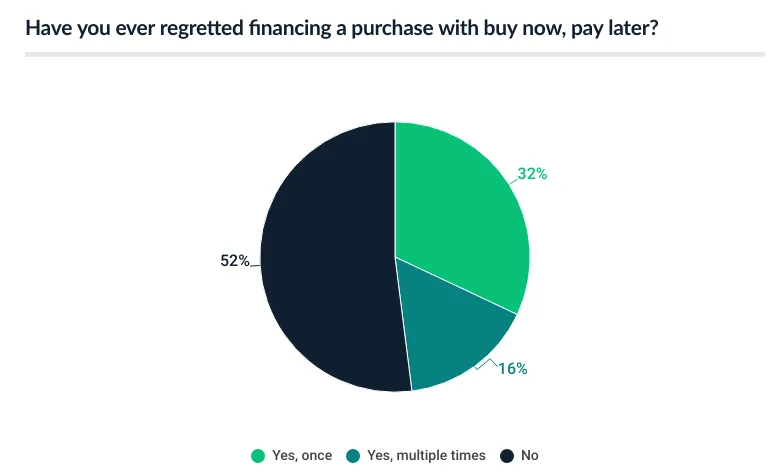
48% of BNPL users have regretted at least one BNPL-financed purchase - 32% once, 16% multiple times. This is not a marginal signal. Nearly half the user base has experienced buyer's remorse on credit-financed purchases. For the 16% who regret multiple purchases, the pattern suggests habitual over-extension: using easy credit to enable purchases that, on reflection, did not represent genuine value. These are the consumers most likely to be juggling multiple active loans, most likely to have lost track of their obligations, and most likely to miss payments when cash flow tightens.
A Bankrate survey found that among BNPL users who experienced problems: 25% reported BNPL made them overspend, 16% missed a payment, 15% regretted the purchase, and 14% had difficulty making returns. PayPal reports that offering BNPL leads to a 91% higher average order value for retailers. These two facts are directly connected. BNPL is remarkably effective at inducing larger purchases. The question is whether those purchases are genuinely affordable or merely deferred regret.
Regulatory Response: Too Little, Too Late?
The regulatory gap around BNPL has been an open secret for years. Until recently, BNPL existed as what some analysts called "phantom debt" - transacted, accumulated, and defaulted on without touching any of the standard credit reporting infrastructure that the financial system relies on to price risk. That has begun to change, but slowly and incompletely.
The three major US credit bureaus have begun receiving data from some leading providers, and the CFPB has increased its scrutiny of the sector. In a notable political signal, minority members of the Senate Banking Committee led by Senator Elizabeth Warren sent letters to the seven leading BNPL providers demanding detailed data on their products, users, and economic role - explicitly citing concern about what the senators described as "opaque" BNPL products being used to pay for groceries and healthcare while the CFPB's enforcement priorities under the Trump administration have shifted away from consumer protection.
FICO Score 10: A Partial Response
In June 2025, FICO unveiled changes to its credit scoring models - FICO Score 10 now includes a BNPL component and works to better capture signals of consumer behaviour by aggregating BNPL loans taken in quick succession. FICO says it collaborated with leaders in the BNPL industry to develop this solution. However: no specific provider names were confirmed, no widespread change in reporting volumes has been made public, and as of mid-2025, the majority of BNPL loans for most consumers are still not appearing in credit bureau data. It is a step in the right direction that does not yet address the core structural problem.
The more fundamental challenge is that BNPL firms have a commercial incentive that runs directly against comprehensive reporting. More complete reporting would expose their borrowers' total obligations to competing lenders - and vice versa - creating natural lending limits that would reduce volume. Without regulatory mandates for comprehensive reporting, the industry's voluntary response will always be partial. The CFPB's current enforcement posture reduces the likelihood of near-term mandatory reporting requirements. The regulatory protection gap is likely to persist through at least 2026.
The Macroeconomic Implications
BNPL's relationship with the broader US economy is genuinely ambiguous - and that ambiguity deserves direct engagement rather than being resolved in either the bullish or bearish direction prematurely.
The bullish case for BNPL's economic function is real. With consumer spending representing approximately 70% of US GDP, and with credit card rates running between 18-30% for many borrowers, BNPL provides cheaper access to credit that sustains consumption volumes that would otherwise contract. PayPal reports a 91% higher average order value for retailers offering BNPL. Affirm, Klarna, and their peers collectively processed billions of transactions that expanded the reach of retail spending to consumers who either lacked credit cards or chose to avoid their interest rates. In a period of persistent inflation, this consumption support has arguably kept retail volumes higher than they would otherwise be, contributing positively to GDP growth figures.
The bearish case is equally grounded in evidence. The Senator Warren letter to BNPL providers noted that consumers with a BNPL loan had, on average, $871 more in credit card debt in the month of origination than a consumer of the same age and credit score who did not take a BNPL loan. BNPL users are not replacing credit card debt - they are stacking on top of it. When we observe retail sales appearing "flat" or GDP consumption holding steady despite deteriorating consumer confidence data, some portion of that stability may be BNPL-financed spending that masks genuine demand weakness. It is borrowed demand from the future - and the repayment schedule will arrive whether or not economic conditions improve.
"The whole BNPL process has potential disaster written all over it. And that's for the retailers accepting BNPL and the consumers using it. Tempting consumers into financial trouble isn't a sustainable business model - it's a ticking time bomb."
- Warren Shoulberg, Industry AnalystInvestment Framework: The BNPL Sector
| Company / Exposure | Bull Case | Bear Case | Key Watch Metric |
|---|---|---|---|
| Affirm (AFRM) | Largest US pure-play; high merchant diversification; growing repeat usage | Charge-off rates sensitive to consumer stress; high cost of capital; no consistent profitability | Delinquency trends, GMV per user, funding costs |
| Klarna (KLAR) | European market dominance; IPO optionality; strong brand in younger demographics | European regulatory tightening; US market still unproven at scale; pricing pressure from incumbents | Active merchant count, credit loss provisions |
| PayPal (PYPL) | BNPL embedded in existing payment infrastructure; massive existing user base | BNPL is a small share of total revenue; competitive pressure from dedicated players; margin pressure | BNPL transaction share, take rate trends |
| Retail Sector (BNPL-reliant) | BNPL increases basket size and purchase completion; customer acquisition at no upfront cost | Higher merchant fees than card networks; customers with poorest long-term profiles; revenue at risk if BNPL tightens | BNPL as % of revenue, customer repeat rates |
| Credit Card Issuers | BNPL delinquency may drive card users back to traditional credit; issuers developing own BNPL products | BNPL balances invisible to card issuers when setting limits; spillover default risk; share loss | Card delinquencies, BNPL product launches |
| Consumer Staples / Discount Retail | BNPL for groceries signals structural shift toward value retailers benefiting from trading down | BNPL consumption is borrowed demand - when it unwinds, discount staples see it first | Same-store sales, traffic per cohort |
Our Conclusion: Lifeline, Liability, or Both?
Analytical Conclusion - August 2025
BNPL is neither the consumer empowerment tool its proponents claim nor the unambiguous debt trap its critics assert. It occupies a genuinely complex middle ground - a financial product that creates real value for some consumers while systematically creating information asymmetries that make the broader credit system less safe for everyone.
The structural problem is not the product itself. It is the reporting architecture. A world in which Affirm, Klarna, Afterpay, and every credit card issuer could see a consumer's total BNPL obligations would be a world in which credit is appropriately priced and extended. We do not live in that world. We live in a world where consumers can stack loans across apps with no single institution seeing the full picture - and where FICO Score 10, while a positive development, has not yet produced the comprehensive reporting change the market actually needs.
From an investment standpoint, we approach BNPL-exposed firms with caution rather than enthusiasm. The 41% late payment rate in the past year is not a marginal signal - it is a majority of the borrower base experiencing payment stress. The fact that 25% of Millennials cannot account for what they owe is not a financial literacy failure - it is a product design consequence that will eventually manifest in credit losses. The delinquency data already visible is almost certainly understated, because unreported loans that go bad simply disappear from the statistics without appearing as formal defaults.
The economy-level question - whether BNPL is propping up consumption that masks genuine demand weakness - does not have a clean answer yet. But when retail sales flatline, consumer confidence deteriorates, and GDP consumption numbers remain relatively resilient, the possibility that BNPL-financed spending is papering over weakness deserves serious weight. Watch Q4 2025 and Q1 2026 GDP consumption components carefully. The unwinding of borrowed demand, if it comes, will not be gradual.
PolyMarkets Investment, Research Team, August 21, 2025