Protocol Overview
Key Facts
What Is Bitcoin?
Bitcoin is the world's first and largest decentralised digital currency, launched in 2009 by the pseudonymous Satoshi Nakamoto. It operates on a proof-of-work blockchain secured by a global network of miners currently operating at approximately 550 EH/s - a level of computational security with no precedent in financial history. Bitcoin's 21 million coin hard cap makes it the only major asset with a mathematically guaranteed finite supply, a property that underpins the "digital gold" thesis and drives the predictable four-year supply cycle at the heart of this tip.
The Halving Mechanism
Approximately every 210,000 blocks (~4 years), Bitcoin's block reward is cut in half. The fourth halving is expected on or around April 19, 2024 - just 10 weeks from today. When it arrives, the block subsidy will fall from 6.25 BTC to 3.125 BTC, cutting daily new Bitcoin issuance from ~900 BTC/day to ~450 BTC/day. At current prices of ~$43,500, that halves the daily sell-side supply from miners from ~$39.2M to ~$19.6M per day. Combined with the institutional demand now channelled through spot ETFs, the supply-demand imbalance from April 2024 onwards is historically the most powerful price catalyst in the Bitcoin cycle.
The ETF Watershed - 4 Weeks In
On January 10, 2024, the SEC approved 11 spot Bitcoin ETF applications. Trading began January 11. This was the single most significant structural event in Bitcoin's 15-year history - creating a regulated, exchange-traded wrapper that opens the asset to pension funds, 401(k) plans, RIAs, and institutional allocators who were previously unable to hold BTC. BlackRock's IBIT and Fidelity's FBTC have seen combined net inflows exceeding $3 billion in their first four weeks. The principal headwind - Grayscale's GBTC conversion - is now normalising: GBTC's $500M+/day initial outflows have slowed significantly as the arbitrage trade is largely unwound, leaving a clearer path for net positive ETF flows to dominate price action.
Strengths & Weaknesses
Strengths
- Spot ETF approval - structural institutional demand channel now open
- Halving in 10 weeks cuts daily supply by 50%, creating a hard supply shock
- 21M hard cap: ~93.3% of all Bitcoin already mined (19.6M / 21M)
- Network hash rate at all-time highs (~550 EH/s) - security and miner confidence signal
Weaknesses
- GBTC conversion outflows still a near-term overhang (~$17B remaining AUM)
- No smart-contract utility - limited to store-of-value and payment use cases
- High volatility: 25-40% intra-cycle drawdowns are common even in bull markets
- Energy-intensive PoW draws ongoing ESG pressure from institutional allocators
Opportunities
- Post-halving supply shock historically drives 12-18 month bull cycles to new ATHs
- ETF products unlock $30T+ in addressable wealth management and pension assets
- GBTC outflow headwind fading - positive net ETF flows increasingly uncontested
- MicroStrategy, nation-states, and corporate treasuries building strategic BTC reserves
Threats
- Fed rate policy: rates still at multi-decade highs - no cuts expected before mid-2024
- Regulatory re-escalation despite ETF approval (SEC could tighten custody rules)
- Macro risk-off event - BTC remains correlated with equities in liquidity crises
- "Buy the rumour, sell the news" dynamic if halving fails to catalyse immediate rally
Risk Areas
Key Risk Factors
Despite the compelling structural setup, this is a high-risk trade. Bitcoin regularly experiences 30-40% drawdowns within bull markets. The GBTC outflow overhang, a still-restrictive macro environment, and the possibility of a "sell the halving" event all represent material near-term risks. The 6-12 month time horizon is designed to absorb near-term volatility while targeting the post-halving cycle peak.
- GBTC Outflow Risk: Grayscale's GBTC still holds ~$17B in AUM as of early February. Continued large-scale redemptions - driven by the 1.5% annual fee vs. competitors charging 0.12-0.25% - represent a persistent sell-side overhang. If outflows accelerate back above $400-500M/day, the price could revisit the $38,000-$40,000 post-ETF launch lows
- Macro Tightening Risk: The Federal Reserve has held rates at 5.25-5.50% - a 23-year high. Markets are pricing rate cuts in mid-to-late 2024, but any re-acceleration in inflation could delay cuts and compress risk-asset valuations, including Bitcoin
- Halving "Sell the News" Risk: The halving on April 19 is well-telegraphed and widely anticipated. Prior cycles (2016, 2020) saw short-term price weakness around the halving event before the sustained post-halving bull run began. Entry at $42k-$45k accounts for this risk, but a dip to $35k-$38k around the halving date is plausible
- Exchange Counterparty Risk: Despite the post-FTX regulatory improvements, centralised exchange failure remains a tail risk. Investors holding BTC on exchanges - as opposed to ETFs or self-custody - retain counterparty exposure
- False Breakout Risk: A weekly close below $35,000 - beneath the post-ETF flush low and the major support band - would invalidate the bullish thesis and triggers the stop-loss level defined in the strategy section
Future Outlook
Pre-Halving Cycle Context
Bitcoin is currently in the pre-halving accumulation phase - the window between the previous cycle low and the halving event that historically offers the best risk-adjusted entry for the subsequent bull cycle. The cycle low was $15,473 in November 2022. The current price of ~$43,500 represents a 181% recovery from that low, yet remains well below the $69,000 ATH set in November 2021. In the prior cycle, BTC was trading at approximately $8,000-$10,000 six months before the May 2020 halving and reached $69,000 eighteen months later - a 7-8x gain. Proportionally, a move from the current $42,000-$45,000 entry to $90,000 within 6-12 months represents a far more conservative and achievable 100% gain.
Price Target Derivation
Three independent methodologies converge on the $88,800–$90,348 target zone, providing high-conviction support for the $90,000 round-number target:
Method 1 - Fibonacci Extension
Wave: Bear market low $15,473 (Nov 2022) → Entry zone midpoint $43,500 = range of $28,027.
1.618× extension (lower entry base): $43,500 + ($28,027 × 1.618) = $43,500 + $45,348 = ~$88,800.
1.618× extension (upper entry base): Using the cycle low ($15,473) to upper entry ($45,000) range of $29,527: $45,000 + ($29,527 × 1.618) = $45,000 + $47,754 = ~$92,700.
The 1.618 Golden Ratio extension of the full bear-market-to-pre-halving recovery wave produces a target zone of approximately $88,500–$93,000 depending on entry basis - a range that comfortably brackets the $90,000 round-number target. These are approximate projections, not precise mathematical guarantees.
Method 2 - Stock-to-Flow (S2F) Model
Current S2F (pre-halving): 19,600,000 BTC ÷ (900 BTC/day × 365) = 19,600,000 ÷ 328,500 = SF ≈ 60. The S2F model at SF=60 implies a price in the $35,000–$50,000 range - consistent with today's entry zone. The current price sits within the S2F-implied range - a necessary but not sufficient condition for model confidence. S2F has faced criticism for its limitations in the post-2021 environment, and we treat it as one directional input among several rather than a precise forecast tool.
Post-halving S2F: 19,700,000 BTC ÷ (450 BTC/day × 365) = 19,700,000 ÷ 164,250 = SF ≈ 120. At SF=120 the model implies a price range of $100,000–$200,000. The 6-12 month target of $90,000 represents a conservative lower bound of the S2F-implied post-halving price regime - achievable well before the model's full SF=120 repricing is complete.
Method 3 - On-Chain Terminal Price
The Terminal Price is derived from Bitcoin's Thermocap (cumulative total miner revenue since genesis) divided by the circulating supply, scaled to the current monetary premium. For the 2024-2025 cycle, on-chain analysts estimate the terminal price - the level at which the cycle historically reaches exhaustion and peak distribution - in the range of $85,000–$95,000. At the current entry price of ~$43,500, BTC is trading at approximately 48% of the terminal price ($43,500 ÷ $90,000 = 48.3%). Historically, entering Bitcoin below 50% of the terminal price has preceded outsized cycle returns. Targeting $90,000 means targeting the lower bound of the terminal price zone - a disciplined, conservative exit consistent with positioning ahead of cycle exhaustion rather than chasing the final speculative spike.
Catalyst Timeline
The next 6-12 months contain a sequenced set of catalysts, each capable of driving price higher: (1) GBTC outflow normalisation and return to consistent positive net ETF flows in February-March 2024; (2) halving supply shock on April 19, 2024, cutting miner daily sell-side supply by 50%; (3) potential Federal Reserve rate cuts beginning mid-2024, improving risk-on conditions; (4) growing secondary ETF approvals (spot Ethereum ETF expected 2024) validating the digital-asset ETF framework; (5) post-halving institutional FOMO as mainstream financial media amplifies the supply-shock narrative.
Post-Halving Cycle Comparison
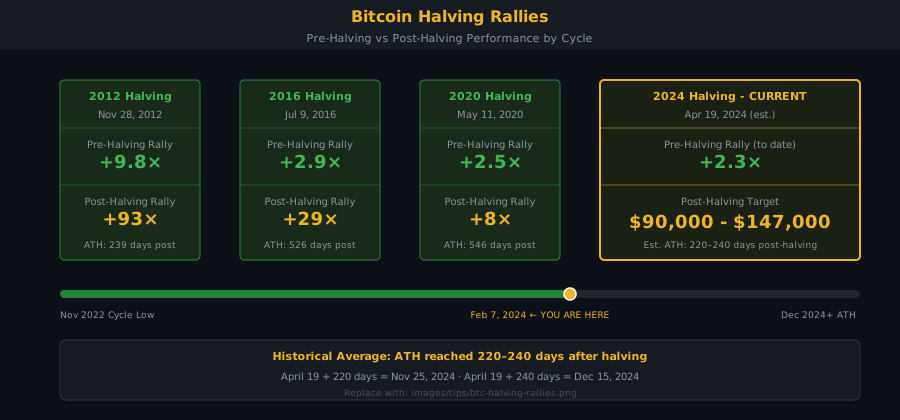
Bitcoin Halving Rallies - Pre-Halving vs Post-Halving Performance by Cycle
Previous halving cycles show that it takes between 220 and 240 days for Bitcoin to reach a new all-time high after a halving - meaning we may not see the next ATH until the very end of 2024. From the April 19 halving date, 220 days lands on November 25 and 240 days on December 15. That gives investors nearly 11 months, or 46 weeks of DCA opportunities from today - or perhaps a chance to explore a more sophisticated staged-entry strategy.
When you think of it that way, a flat or sideways crypto market between now and the halving may well be a blessing in disguise. Let the Federal Reserve navigate the choppy waters of its first interest rate cut decision of this cycle - widely expected mid-to-late 2024 - and be positioned well before the bull market gets into full swing. Patient accumulation in the $42,000–$45,000 zone now is the asymmetric setup; the cycle clock has already started.
Competitor Analysis
Bitcoin holds approximately 53% dominance of the total crypto market cap - near its highest since the 2021 bull peak - reflecting the "ETF premium" effect: institutional flows are overwhelmingly directed at Bitcoin as the only currently approved spot ETF product in the US. Altcoins remain structurally disadvantaged relative to BTC until their own ETF frameworks are approved, making Bitcoin the highest-conviction institutional entry into the crypto asset class for this tip's time horizon.
| Asset | Market Cap | Consensus | Key Advantage |
|---|---|---|---|
| Bitcoin (BTC) | ~$853B | Proof-of-Work | Only approved spot ETF, digital gold, halving |
| Ethereum (ETH) | ~$312B | Proof-of-Stake | Smart contracts, DeFi, but no spot ETF yet |
| Solana (SOL) | ~$48B | Proof-of-History | High throughput recovery from FTX collapse |
| XRP (XRP) | ~$29B | XRP Ledger | Cross-border payments, SEC lawsuit ongoing |
Ethereum (ETH)
ETH at ~$2,600 is the second-largest crypto asset and leads in smart contracts, DeFi, and developer activity. However, no spot Ethereum ETF has been approved - that decision is expected sometime in mid-2024. Until then, ETH lacks the institutional inflow mechanism that is now structurally supporting Bitcoin prices. ETH/BTC ratio has been declining as institutional money flows preferentially into Bitcoin.
Pros
- Smart contract dominance
- Proof-of-Stake efficiency
- Spot ETF expected 2024
Cons
- No spot ETF approved yet
- L2 fee cannibalisation
- ETH/BTC losing ground
Solana (SOL)
SOL at ~$110 has mounted an impressive recovery from the FTX collapse lows of $8 in December 2022. The high-performance Layer-1 has rebuilt developer confidence and is attracting DeFi and consumer app activity, but it remains associated with the FTX ecosystem in some institutional minds and has no ETF pathway. A speculative play compared to Bitcoin's institutional-grade risk profile at this stage of the cycle.
Pros
- Strong post-FTX recovery
- High TPS, low fees
- Growing DeFi ecosystem
Cons
- FTX association overhang
- No ETF pathway near-term
- History of network outages
XRP (XRP)
XRP at ~$0.55 is still under an active SEC enforcement action (Ripple lawsuit), which acts as a ceiling on institutional adoption despite the partial court victory in July 2023. Cross-border payment utility is real but niche, and the regulatory cloud will persist until the SEC case is fully resolved - expected sometime in 2024-2025. Too much legal uncertainty to compete with Bitcoin for institutional allocation in this cycle's early stage.
Pros
- Partial court victory (Jul 2023)
- Fast, cheap settlements
- Bank partnership pipeline
Cons
- SEC lawsuit unresolved
- No institutional ETF access
- Centralised supply structure
Bitcoin's Structural Lead in This Cycle
Bitcoin is the only crypto asset with a live, SEC-approved spot ETF - a regulatory moat that none of its competitors currently share. Combined with the imminent halving supply shock, BTC has a dual catalyst that no other digital asset can match for the 6-12 month horizon. This is the strongest fundamental setup Bitcoin has ever presented to institutional investors.
Technical Analysis
Technical Indicators
- 4H MACD - The MACD is now losing momentum in the bullish zone.
- 4H RSI (Relative Strength Index) - The RSI is now above the 50 level.
- Key Support Levels - $42,600 and $41,200.
- Key Resistance Levels - $43,320, $43,500, and $44,500.
Note: The upper end of the entry zone ($43,500-$45,000) approaches the key resistance cluster identified above. Prioritise entries in the $42,000-$43,200 range for optimal positioning ahead of the expected breakout confirmation. Entries above $43,500 should be sized conservatively, treating resistance as a potential near-term ceiling before a decisive weekly close opens the path higher.
Technical Outlook
Bitcoin is recovering from the post-ETF "sell the news" flush that took price from ~$47,000 to ~$38,000 in the weeks immediately following the January 10 approval. The $38,000-$40,000 zone has held as strong support on every test, establishing a clear higher low relative to the November 2022 cycle bottom of $15,473. The $42,000-$45,000 entry zone represents the recovery from that support - a re-entry above the critical $41,500 level that was the pre-ETF breakout base.
The 200-week moving average, currently near $27,000, remains a distant structural floor confirming we are firmly in a new bull market. The 21-week EMA sits near $38,500 and has provided reliable support throughout the recovery from the cycle low. First resistance sits at $48,000-$49,000 (the pre-ETF approval high). A weekly close above $49,000 opens a clear path to the $68,000-$69,000 prior cycle ATH zone, and beyond that, the 1.618 Fibonacci extension target of $88,848-$90,348.
Risk/Reward calculation: Entry midpoint $43,500 | Stop-loss $35,000 (−$8,500 / −19.5%) | Target $90,000 (+$46,500 / +106.9%) → R/R = 1 : 5.5
Investment Strategy
The following scenarios reflect the author’s personal analysis and are not investment recommendations. See our full disclaimer.
Recommendation
A staged accumulation approach for Bitcoin in the $42,000-$45,000 entry zone over 2-3 tranches. The dual catalyst of ETF structural inflows and the imminent halving supply shock creates one of the most asymmetric risk/reward setups in Bitcoin's history. A 1:5.5 risk/reward at disciplined position sizing is appropriate for high-risk allocators. The 6-12 month time horizon targets the $90,000 level, derived from the convergence of Fibonacci extension ($88,848-$90,348), Stock-to-Flow post-halving repricing, and the on-chain terminal price indicator. Consider trimming at $68,000-$69,000 (prior ATH zone) and take the primary exit at $88,000-$90,000.
Action Plan
- Scenario Entry Range: $42,000–$45,000. Tranche 1 (50%): $43,000–$45,000 immediately. Tranche 2 (30%): $40,000–$42,000 if a dip to the ETF-launch support zone occurs. Tranche 3 (20%): $38,000–$40,000 as a max drawdown add near the 21-week EMA, should the "sell the halving" event materialise in April
- Risk Consideration: 4-8% of portfolio for risk-tolerant investors; 1-3% for conservative allocators. The 1:5.5 R/R justifies meaningful sizing, but Bitcoin's volatility requires strict discipline on maximum allocation
- Upside Scenario Milestones: First partial exit (20% of position) at $68,000–$69,000 (prior cycle ATH - expect resistance); main exit (70% of position) at $88,000–$90,000 (Fibonacci + S2F + terminal price convergence); hold remaining 10% for any extension beyond $90,000
- Thesis Invalidation Level: Weekly close below $35,000 invalidates the bullish thesis. This is 19.5% below the entry midpoint and sits below the entire post-ETF launch support structure. A close at this level signals either structural breakdown or a macro shock suggesting the thesis no longer holds
- Watch for Halving-Period Volatility: Expect heightened price swings around April 19, 2024. The "sell the halving" dynamic - where a well-anticipated event triggers profit-taking - could produce a $35,000-$40,000 dip before the post-halving rally resumes. Maintain positions and use Tranche 3 if the dip materialises
- Access Method: Spot Bitcoin ETFs (IBIT, FBTC) for brokerage and IRA accounts - the new ETF wrapper eliminates custody risk and offers institutional-grade liquidity. Direct self-custody via hardware wallet for larger holdings seeking maximum control. Avoid GBTC due to its 1.5% management fee vs. 0.12% for IBIT/FBTC
Important Disclaimer
This content is for informational and educational purposes only and does not constitute financial advice, investment recommendations, or solicitation to buy or sell any securities or crypto assets. Cryptocurrency investments carry extreme volatility risk including the possibility of total loss of invested capital. Past halving-cycle performance does not guarantee future results. Fibonacci extension, Stock-to-Flow, and on-chain terminal price targets are quantitative models based on historical data - they are not guaranteed outcomes. Always conduct your own research and consult a qualified financial advisor before making investment decisions. The authors and publishers are not responsible for any financial losses resulting from the use of this information.