Consider PREMIUM MEMBERSHIP to get upfront access to undiscovered trends shaping future markets - and success to make informed decisions. Unsubscribe anytime.
Market Tips with detailed scenario analysis and research
Scenario analysis, research breakdowns and respective target zones
Industry & sector research with full fundamental & technical analysis
We've sent you a confirmation email. Click the link to activate your free access.
Something went wrong. Please try again.
Cryptocurrency - DeFi & Altcoins
Altcoins & DeFi Ecosystem
Beyond Bitcoin - The Innovation Layer of Crypto
December 2025 30 min read Intermediate
DeFi TVL (ATH)
$178B+
Active Altcoins
10,000+
Altcoin Market Cap
$1.2T+
DEX Annual Volume
$1T+
Research Desk Briefing - Altcoins & DeFi Ecosystem
If Bitcoin is digital gold - a store of value secured by mathematics and enforced scarcity - then altcoins are literally everything else. The infrastructure. The financial plumbing. The governance mechanisms and the entire application layer getting built on top of that monetary foundation. And here's what a lot of Bitcoin maximalists won't tell you: most crypto innovation over the past decade didn't come from Bitcoin at all. It came from Ethereum, from DeFi protocols, from Layer 1 chains competing on speed and cost, and from thousands of token ecosystems pulling in developers and capital. Ignoring this landscape in 2025 isn't a philosophical stance. It is a blind spot.
So what does this course actually cover? We start with what altcoins are and why they exist - not the marketing version, but an honest accounting of the trade-offs. Then we get into DeFi: its structure, why it matters as financial architecture, what the data says about real growth versus hype. We profile protocols generating actual revenue, break down altcoin season dynamics, and hand you a research framework that works on any project. The final sections deal with risk. Bluntly. Because this space has produced both life-changing returns and portfolio-destroying losses - sometimes in the same month.
Read it like a market researcher would. Curious but sceptical. And with a clear sense of what you're trying to understand before you put money to work.
- The PolyMarkets Research Desk
Course Roadmap - 10 Sections
What Is an Altcoin History & Timeline Altcoin Categories Bitcoin vs Altcoins What Is DeFi DeFi Technology Stack Key DeFi Protocols Buying & Storage Research Framework Risks & Pitfalls
1 What Is an Altcoin - and Why It Exists
"Altcoin" is shorthand for "alternative coin" - literally every cryptocurrency that is not Bitcoin. Roughly 10,000 active projects as of 2025. Each one a different team, a different set of engineering trade-offs, a different bet on what blockchain technology should actually do.
Bitcoin was purpose-built as peer-to-peer electronic cash. Does that job well. But the design makes deliberate sacrifices - security and decentralization get priority over flexibility. You cannot run a lending protocol on Bitcoin. Can't build a decentralized exchange on it. Can't issue governance tokens or programmable financial contracts. Developers who wanted those things had to build different infrastructure from the ground up. That's where altcoins came from. Not rebellion against Bitcoin - frustration with its constraints.
I think of Bitcoin as the monetary foundation. Disciplined, conservative, deliberately hard to change. Altcoins sit on top as the innovation layer. Some compete with Bitcoin directly - faster blocks, better privacy, more scalability. But most aren't trying to replace Bitcoin at all. They are building entirely different categories of software that happen to use blockchain as the trust mechanism underneath. Honest assessment? Ethereum has more in common with AWS than it does with Bitcoin, once you look at what it actually does day to day.
"Calling altcoins 'alternatives to Bitcoin' misses the point entirely. They are the engines driving innovation across blockchain technology. Decentralised infrastructure, Web3 applications, programmable finance - the altcoin ecosystem keeps pushing the boundary of what is possible in the crypto economy."
- PolyMarkets Research Desk
Here is the number that should grab you: altcoins now account for more than 50% of total crypto market capitalization. More than half. If you still treat the crypto market as "Bitcoin plus noise," you are ignoring the majority of the asset class by market cap. Whether you personally allocate to altcoins - that's a risk management call, and reasonable people land on different sides. But understanding what they are, how they function, what drives their value? Not optional. Not if you're serious about any of this.
Market structure note: Altcoins move with Bitcoin but amplify the direction. Bull markets? Many deliver multiples of Bitcoin's return. Bear markets? Many lose 80-95% while Bitcoin drops 50-70%. That asymmetry is the entire risk/reward story of altcoin investing, full stop. Higher ceiling. Much deeper floor.
2 History of Altcoins - From Litecoin to Web3
The altcoin market didn't just appear one day, fully formed. It grew in waves - each one introducing new capabilities, attracting different flavors of capital, and leaving behind a trail of expensive lessons. Why bother with the history? Because the patterns repeat. Every single cycle, a fresh batch of investors walks into the same traps that wiped out the previous generation. Knowing what happened in 2017 can save you real money in 2026.
11
2011
Litecoin - Silver to Bitcoin's Gold
First altcoin that actually mattered. Charlie Lee, ex-Google engineer, swapped Bitcoin's SHA-256 for Scrypt hashing and cranked the block time to four times faster. The "silver to Bitcoin's gold" pitch was dead simple. And it worked - proved that Bitcoin's design choices were one option among many, not some final answer carved in stone.
15
2015
Ethereum - The World Computer
The big one. Ethereum brought programmable smart contracts to the table and turned blockchain from a payment rail into something closer to a global computing platform. DeFi, NFTs, DAOs, stablecoins - every major crypto innovation since traces its technical DNA back here. Vitalik Buterin basically changed the question from "how do you transfer value?" to "what can you build when money itself becomes programmable?" And the industry hasn't recovered from that question since. In a good way.
17
2017–18
The ICO Boom - Thousands of Projects
ICOs let any team with a whitepaper and a dream raise millions by issuing tokens on Ethereum. Thousands of projects launched. Billions poured in. Most failed - many were outright scams. But the era did introduce utility tokens and decentralized funding as real concepts, even as it created the first mass-casualty event for retail crypto investors. The lesson? Brutal and simple. Narrative can outrun fundamentals for a terrifyingly long time.
20
2020
DeFi Summer - Finance Without Banks
Compound Finance started distributing governance tokens as yield in June 2020 and something just... broke loose. TVL went from under $1 billion to over $15 billion in months. Uniswap, Aave, Curve, MakerDAO became household names in crypto circles practically overnight. What DeFi Summer actually proved was something skeptics had dismissed for years: that open-source financial protocols could attract institutional-scale capital without a single human being managing the funds. No fund manager. No compliance department. Just code.
21
2021
NFTs, Meme Coins & Multi-Chain Expansion
NFTs blew up into mainstream consciousness. Dogecoin surged 12,000% on Elon Musk tweets alone - proof that internet culture could move billions in market cap with zero fundamental backing. Wild. Solana emerged as a legitimate Ethereum competitor, processing thousands of transactions per second at sub-cent fees. The multi-chain world everybody had been theorizing about? It just happened. No grand announcement, no coordinated launch. One day there were multiple real ecosystems competing for users and capital.
25
2023–2025
Institutional DeFi & Real World Assets
Terra/LUNA and FTX blew up spectacularly, and the survivors rebuilt with actual risk management this time around. The dominant story of 2025 is tokenization of Real World Assets - US Treasury bills, real estate, private credit all moving on-chain. BlackRock and Franklin Templeton are active participants in permissioned DeFi now. Sit with that for a second. BlackRock. In DeFi. The question stopped being "will traditional finance adopt blockchain rails?" sometime in 2024. Now it's just about how fast.
3 Six Categories of Altcoins
Ten thousand altcoins sounds overwhelming. It's not, once you realize they cluster into roughly six buckets - and projects in different buckets aren't really competing with each other at all. Ethereum is not trying to do what Dogecoin does. Chainlink has nothing in common with Monero. Figure out which category a project belongs to and you immediately know what success looks like for it, what metrics matter, and - this is the important part - what valuation framework actually makes sense to apply.
Smart Contract Platforms
Layer 1 / Infrastructure
Base-layer blockchains where everything else gets built. DeFi, NFTs, Web3 apps - all running on these platforms. The competition comes down to speed, cost, developer experience, and ecosystem size. Ethereum wins on depth and institutional trust. Solana wins on raw throughput. Everyone else? Fighting for third place, frankly.
Tokens issued by DeFi protocols - they give holders voting rights on governance decisions and sometimes a cut of protocol revenue. Value here tracks the underlying protocol's success directly. Lending protocol processing billions in real loans? Its governance token accrues genuine value. Activity dries up? So does the token. Straightforward cause and effect, which is refreshing in a market where most price action seems disconnected from reality.
You need these tokens to access specific platform services. Think subway tokens for a particular blockchain service. Demand comes from actual usage, not speculation - more people using the platform, more demand for the token. But here's the catch that trips people up: many utility tokens are structurally dilutive. The protocol keeps minting new ones to incentivize participation, creating permanent sell pressure that the demand side has to overcome just to break even.
Pegged to fiat currencies or commodities. Technically altcoins, but nobody buys them expecting appreciation - that is literally the point. They are the liquidity backbone of the entire crypto market, enabling trading, DeFi participation, and cross-border payments without crypto volatility. Visa reported over $1 trillion in stablecoin transactions in 2024. A trillion dollars. That is not speculative volume. That's infrastructure. Plumbing.
Key projects: USDC (Circle), USDT (Tether), DAI (MakerDAO), PYUSD (PayPal)
Security Tokens
Regulated Ownership
Regulated ownership of real-world assets - stocks, real estate, bonds, fund units - all represented as blockchain tokens. Issued under applicable securities law via STOs, not ICOs. They unlock fractional ownership of previously illiquid assets, though they come with heavier regulatory scrutiny (which, honestly, is probably a feature rather than a bug). The 2025 RWA boom pushed security tokens closer to mainstream adoption than anything before it.
Key projects: RealT (real estate), Ondo Finance (US Treasuries), Maple Finance (private credit)
Meme Coins
Community / Speculative
Internet culture made investable. Dogecoin launched as a literal joke in 2013 and now sits at a multi-billion dollar market cap. No technical moat. No revenue model. No utility beyond community vibes. And yet these tokens do demonstrate something genuinely interesting about how consensus creates value out of thin air. They also carry the highest risk of going to zero overnight. Both statements are completely true at the same time, which tells you a lot about this market.
People frame this as Bitcoin versus altcoins, like you have to pick a side. You don't. The two serve fundamentally different roles in a portfolio. Comparing their price performance without grasping the structural differences underneath - that's how investors end up making bad allocation decisions and then blaming "the market" for outcomes their own framework guaranteed.
Dimension
Bitcoin (BTC)
Altcoins
Primary Purpose
Store of value / digital gold
Smart contracts, DeFi, governance, payments, gaming - varies by project
Consensus Mechanism
Proof of Work (PoW) - energy-intensive, proven security model
Mostly Proof of Stake (PoS) or hybrid - energy-efficient, different security assumptions
Supply Model
Hard cap at 21 million - mathematically enforced scarcity
Highly variable - some deflationary, many inflationary, some without supply caps
Institutional Adoption
ETFs, corporate treasuries, national reserves - broadest institutional acceptance
Growing (Ethereum ETFs approved in 2024) but far behind Bitcoin's institutional maturity
Volatility Profile
High by traditional standards; relatively lower within crypto
Significantly higher - 80–95% drawdowns common in bear markets for smaller caps
Liquidity
Deepest liquidity in crypto - trades on every exchange globally
Variable - large caps liquid; smaller caps can have severe slippage in large positions
Regulatory Clarity
Broadly classified as commodity in most jurisdictions; most regulatory certainty
Ongoing uncertainty - many altcoins face potential securities classification
Upside Potential
Lower percentage upside at current market cap; structural institutional bid
Higher percentage upside due to lower starting market caps and faster innovation cycles
Portfolio lens: Most experienced crypto investors I've talked to treat Bitcoin as their base - the position they're most comfortable holding through a full cycle without losing sleep. Altcoins fill satellite slots for higher-risk, higher-reward bets where they have genuine conviction in a specific ecosystem or thesis. The ratio between the two? Entirely personal. Someone with a 10-year horizon and a strong stomach might go 50/50. Someone closer to retirement probably has no business being above 80/20 BTC-heavy. Know yourself before you allocate.
5 What Is DeFi - The Architecture of Trustless Finance
DeFi is not a new product. It's a new architecture. For centuries, moving value meant trusting intermediaries - banks holding your money, clearinghouses settling your trades, payment processors deciding whether your transaction gets approved. DeFi strips out the intermediary. Replaces institutional trust with verifiable code. Once you genuinely internalize what that means, it changes how you think about the whole financial system. I'm not being dramatic here. It really does.
The core distinction is simple. In traditional finance, you trust. Trust the bank to manage your deposit, honor your withdrawal, not run off with your funds. In DeFi, you verify. The code is open-source. Logic is predetermined. The smart contract executes exactly as written regardless of who is asking or whether it's 3am on a Sunday. No human being involved in the transaction. Nobody can block it, reverse it, or skim a cut beyond what the protocol's code specifies upfront.
Traditional Finance (TradFi)
Hub-and-Spoke Model
Centralised institutions act as mandatory gatekeepers for every transaction
Requires KYC, credit checks, and permission to access most financial services
Settlement takes 1–3 business days (T+2); closed nights, weekends, and holidays
Fees paid to intermediaries (banks, brokers, clearinghouses) for every step of a transaction
Accounts can be frozen, transactions reversed, and access blocked by institutions or regulators
Decentralised Finance (DeFi)
Peer-to-Protocol Model
Smart contracts replace intermediaries - code executes automatically when conditions are met
Permissionless access - anyone with an internet connection can use any protocol
Settlement in minutes, seconds, or sub-second on high-performance chains. 24/7/365.
Fully transparent - every transaction, reserve, and protocol decision is on-chain and publicly auditable
Fees go to liquidity providers and validators - the participants - not the intermediaries
Self-custody by default - you control your assets at all times; no one can freeze a smart contract position
An analogy that actually helps: traditional finance is like the postal service. You go to a physical branch during business hours, identify yourself, hand over the item, trust the institution to deliver it. DeFi is like email. Hit send. The protocol handles delivery instantly, globally, automatically - no human intermediary reading your message or approving the transmission. Shared infrastructure. No trust required between parties. The result is a system running at internet speed instead of banking speed. And that gap in speed is not small.
Why this matters structurally: The DeFi market reached an all-time high of roughly $178 billion in Total Value Locked in 2021 - up from under $1 billion in early 2020. That kind of growth is not just retail speculators chasing yields. A meaningful chunk of that capital is institutional money testing infrastructure that settles faster and more transparently than anything the traditional financial system can offer at equivalent cost.
6 The DeFi Technology Stack
DeFi is not one thing - it's a stack of three technologies working together to create what amounts to an autonomous financial system. Break down each layer and you start to see why DeFi can do things traditional finance simply cannot. And where the current limitations come from, because there are real ones.
1
Foundation
The Settlement Layer - Blockchain
The blockchain itself - an immutable ledger recording every transaction across thousands of computers simultaneously. Can't be shut down by a single entity, altered by an administrator, or selectively censored. Ethereum pioneered this layer for DeFi. By 2025, high-performance Layer 1 chains (Solana, Sei, Avalanche) and Layer 2 networks (Arbitrum, Base, Optimism) had driven transaction costs down to fractions of a cent. That made DeFi economically viable for smaller users, not just institutions with enough capital to absorb gas fees.
2
Logic
The Logic Layer - Smart Contracts
Self-executing programs stored permanently on the blockchain. They work as If/Then statements: "IF User A deposits 1,000 USDC into this pool, THEN issue receipt tokens representing their share plus accruing interest." Once deployed, they run autonomously. Don't sleep. Don't take holidays. Can't be bribed. Don't discriminate between users. Logic is fixed at deployment - and that immutability is simultaneously the greatest strength and the greatest risk. A bug in the code will be exploited just as reliably as the correct logic functions. No exceptions.
3
Interface
The Interface Layer - dApps
Decentralised Applications - dApps - are the front-end interfaces users interact with. They look like standard fintech websites or mobile apps. But instead of connecting your credentials to some company's database, they connect your personal crypto wallet directly to the on-chain protocol. No account creation. No identity verification. No counterparty sitting between you and your assets. By 2025, dApp interfaces have gotten polished enough that many casual users have no idea how much infrastructure complexity is running underneath. Which is exactly how good software should work.
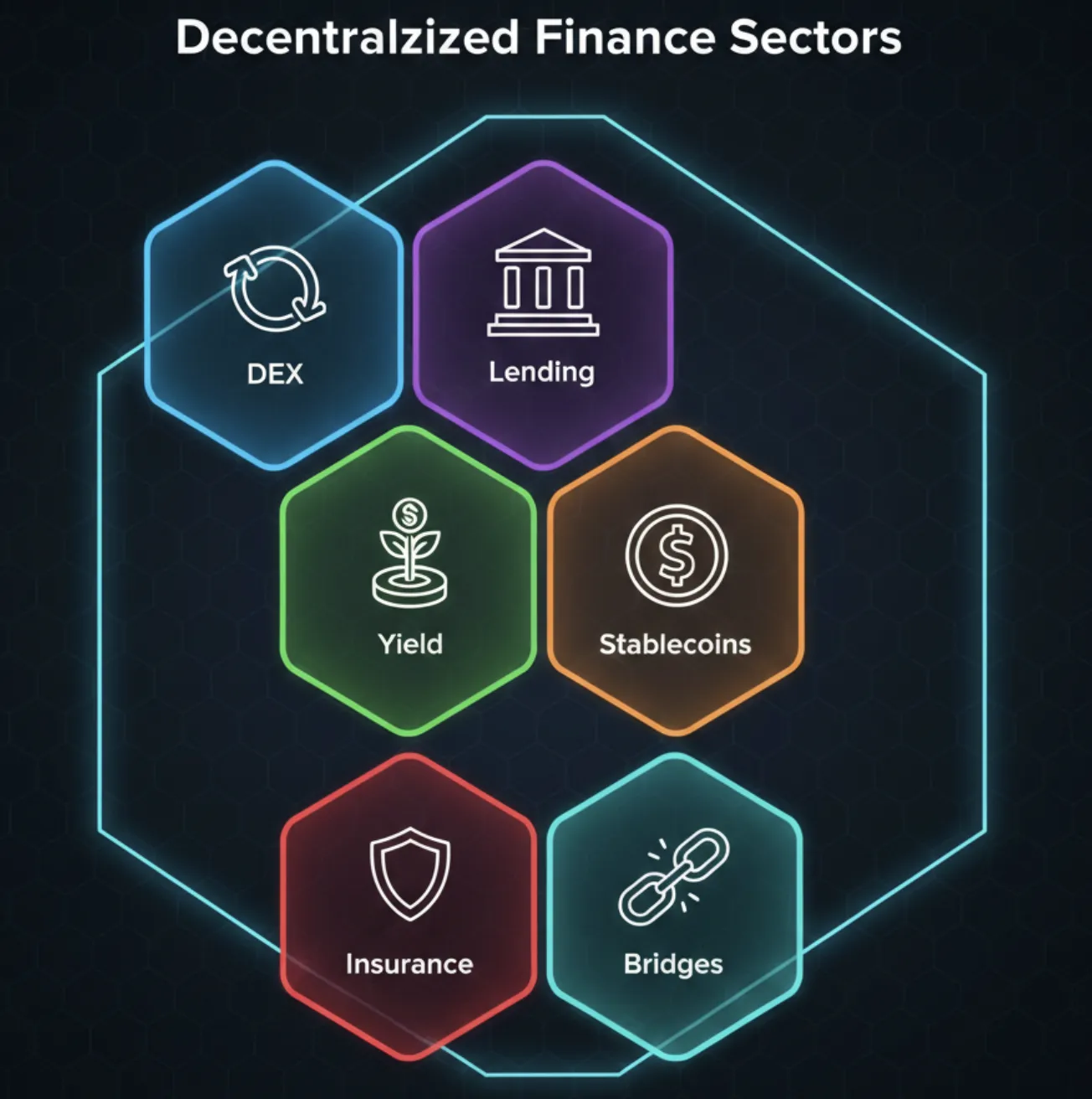
The six primary sectors of the DeFi ecosystem, each representing a different financial service rebuilt on open-source blockchain infrastructure.
Those six sectors above? They represent the complete functional architecture of DeFi. DEXs handle peer-to-peer token swaps without a central exchange holding custody. Lending protocols let users earn yield or borrow against collateral - no credit check, no paperwork. Yield strategies help people optimise returns across multiple protocols. Stablecoins provide price-stable liquidity as the medium of exchange (the oil in the machine, basically). Insurance protocols protect against smart contract failures. And bridges connect value across separate blockchains so the multi-chain ecosystem can function as one unified economic system rather than a bunch of isolated islands.
7 Key DeFi Protocols - Who Is Building Real Finance
Early DeFi was dominated by speculation. Teams issuing tokens with insane yield incentives to attract liquidity that would vanish the moment anything went wrong. The survivors and leaders of 2025 look nothing like that. These protocols generate real revenue, maintain genuine TVL through full market cycles, and attract serious developer talent. Here are four of the most established - the ones that actually made it through.
AAVE
Aave
Lending & Borrowing Protocol
The dominant decentralised lending protocol. Deposit collateral to borrow other assets, or lend your assets and earn algorithmic interest. Collateral ratios and liquidations enforced automatically by smart contracts - no credit check, no paperwork, nobody approving anything. The AAVE governance token gives holders voting power over protocol parameters plus a stake in the Safety Module that backstops against insolvency events. Been battle-tested through multiple market crashes at this point.
Community-owned decentralised exchange that launched as a fork of Uniswap back in 2020. The differentiation play was simple: distribute token rewards to liquidity providers who migrated over from competing protocols. Worked well enough. Today Sushi runs as a full DeFi suite - DEX, lending, cross-chain swaps - governed entirely by SUSHI token holders. One of the clearest real-world examples of a community-driven governance model actually functioning.
CategoryDEX / Governance
Chain30+ networks
Token utilityGovernance votes + fee revenue
LDO
Lido DAO
Liquid Staking
Lido solved a specific, annoying problem: Ethereum staking required locking up 32 ETH minimum with zero liquidity. Lido issues stETH as a liquid receipt token for any amount staked, so users earn Ethereum network rewards while still deploying that capital elsewhere in DeFi. The LDO governance token controls protocol parameters. Lido became the largest single staking provider on Ethereum - which, yes, raises legitimate concentration risk questions that the community debates pretty actively. Dominance cuts both ways.
CategoryLiquid Staking / Governance
ChainEthereum (primary)
Token utilityGovernance votes over validator set
CRV
Curve Finance
Stablecoin DEX
Curve specialises in one thing and does it extremely well: low-slippage trading between assets that should hold similar value. Stablecoins, wrapped tokens, liquid staking derivatives. Its AMM design is built specifically for near-peg assets rather than volatile pairs, making it essential plumbing for stablecoin liquidity across DeFi. The CRV governance model introduced vote-escrowed tokenomics (veCRV) - a mechanism that has been copied by dozens of other protocols because it actually aligns long-term incentives between token holders and protocol health.
CategoryStablecoin DEX / Governance
ChainEthereum + multiple L2s
Token utilityVote-escrowed governance + fee share
DeFi's Second Renaissance - The 2025 Recovery Story
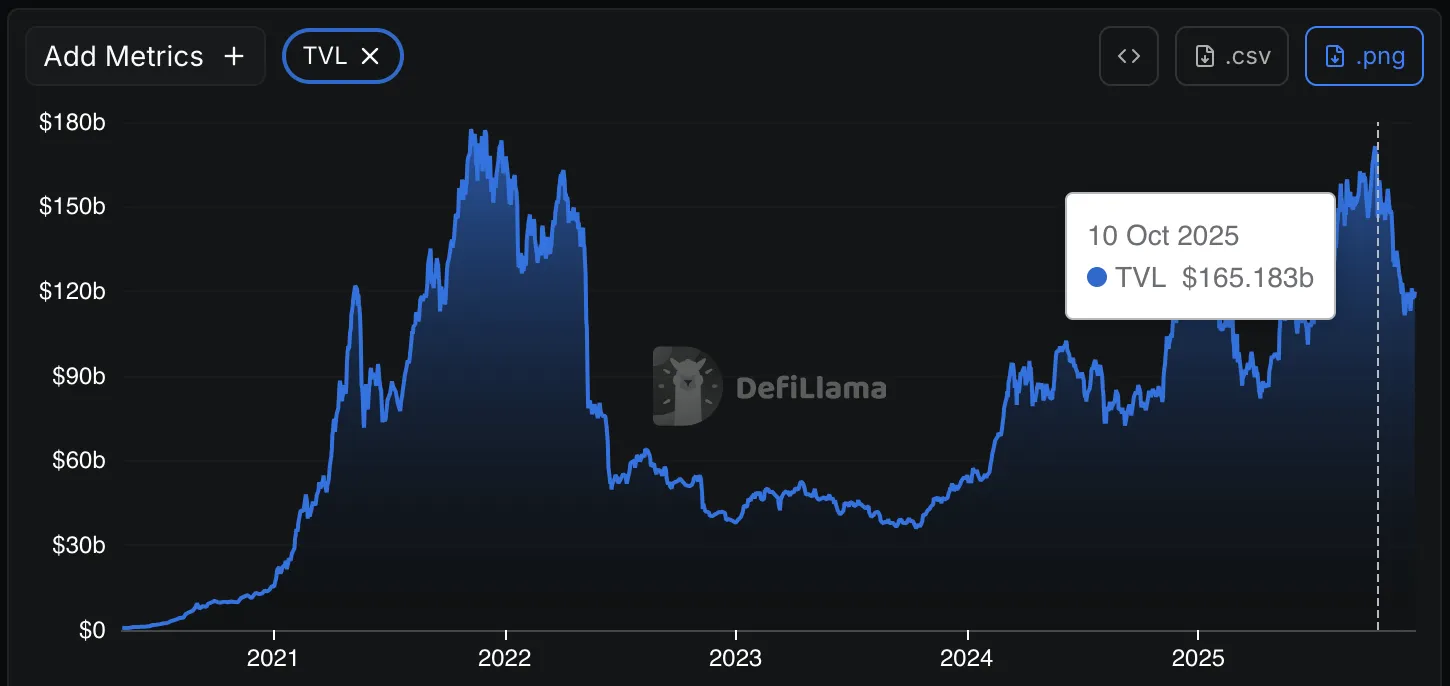
DeFi entered 2025 with something it hadn't seen in nearly three years: genuine recovery driven by real usage, not speculative bursts. TVL climbed from $115 billion to more than $161 billion by Q3 2025. A structural rebound, not a narrative-driven spike. But what made this cycle distinct wasn't the headline number - it was what the capital was actually doing. Where it was moving. And why certain sectors were earning real revenue rather than just attracting deposits through unsustainable yield incentives.
DeFi's lowest point this cycle came in August 2023. TVL bottomed near $38 billion. The decline exposed real structural fragilities - fractured liquidity, slowed innovation, eroded trust. But that reset ultimately served the industry well. Protocols rebuilt their security foundations, shed unsustainable incentive models, and refocused on generating genuine economic activity. By December 2024, TVL had crossed $130 billion. Slow recovery. Steady. And unmistakably structural rather than hype-driven.
DeFi TVL 2020–2025 (DefiLlama). The 2021 peak near $180B, the 2022–2023 contraction to $38B, and the disciplined 2024–2025 recovery to $165B are visible - each phase distinct in its drivers and character.
Q1 2025
~$115B TVL
Defensive Start
Liquid staking and lending dominated the landscape at $60B+ and $50B+ respectively. RWAs expanded sharply to $9.6B - first real signal that tokenised treasury-backed instruments had genuine institutional demand behind them.
Q2 2025
~$130B TVL
Capital Rotation
Lending surged back to $52B. Liquid staking rebounded to $46B. RWAs kept climbing to $11B, transitioning from what had been a side experiment into a viable, infrastructure-backed category with real money flowing in.
Q3 2025
$161B+ TVL
Synchronized Expansion
Broad, simultaneous advance across the board. Lending rose to $84B, liquid staking to $80B, bridges to $63B. RWAs hit $15B. No single catalyst driving it. Just broad-based structural health showing up in the numbers.
Q4 2025
$160B+ TVL
Consolidation & Depth
TVL held its gains without explosive new growth. Fewer, larger protocols with stronger risk controls took market share. RWAs finished the year near $16B. The vibe shifted from momentum to discipline. Boring, maybe. But healthier.
Ethereum Reclaimed the Centre - But New Execution Layers Changed the Map
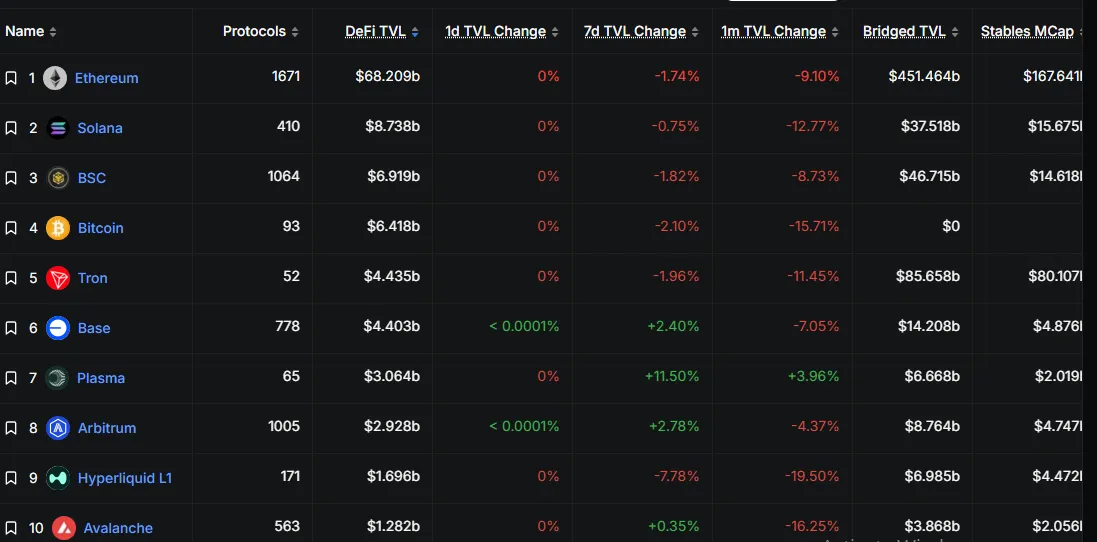
Q3 marked a decisive shift in DeFi's geographic layout. ETH-based TVL climbed back above 50% of total DeFi - users gravitating toward Ethereum's unmatched stability, liquidity depth, and infrastructure maturity. But the base layer alone didn't power the resurgence. Arbitrum (2.18%) and Base (3.17%) contributed sustained activity. Plasma, a high-throughput execution layer optimised for stablecoin velocity, captured over $1 billion in pre-deposits before mainnet even launched and cracked the top 10 chains within weeks. Hyperliquid's TVL went from roughly $1B in July to ~$6B by September. Rather than diluting Ethereum's relevance, these execution environments actually amplified it - creating a multilevel architecture where L2 and appchain activity flows back into Ethereum's settlement layer. The whole ecosystem got bigger, and Ethereum got more central, not less.
Top 10 chains by DeFi TVL (DefiLlama). Ethereum dominates at $68B with 1,671 protocols. Solana, BSC, Bitcoin, Base, and Plasma form the second tier - each with distinct liquidity profiles and ecosystem drivers.
Real World Assets - From Curiosity to Institutional Glue
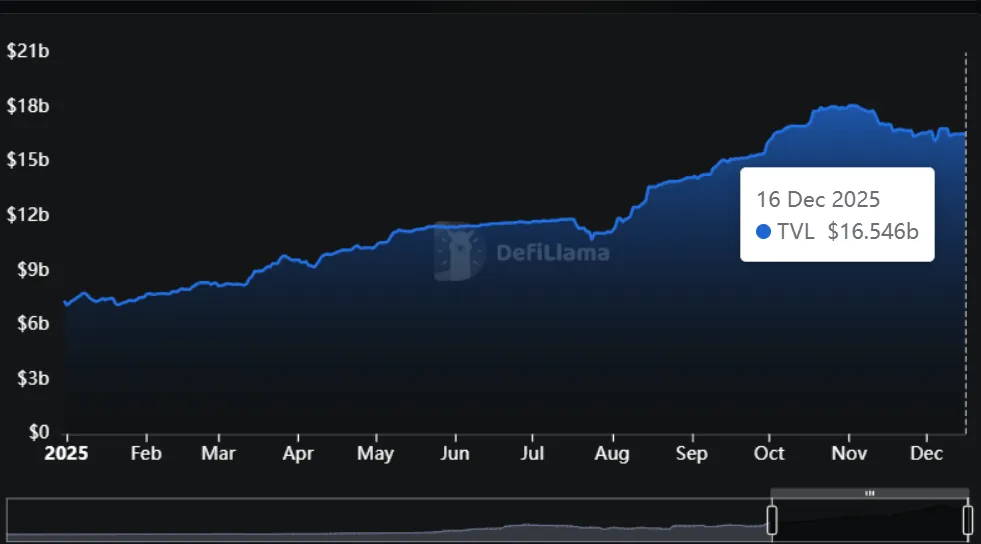
By 2025, tokenisation of real-world assets had clearly left the experimental phase. Total RWA protocol TVL grew from roughly $8 billion at the start of the year to over $16 billion by year-end. A ~100% increase, driven by institutional demand for tokenised credit and treasury instruments. This was not play money. Asset managers were deploying working financial tools - tokenised US Treasuries, private credit pools, fully-backed commodity tokens offering 24/7 access with verifiable on-chain reserves. Two standout performances really drove the point home.
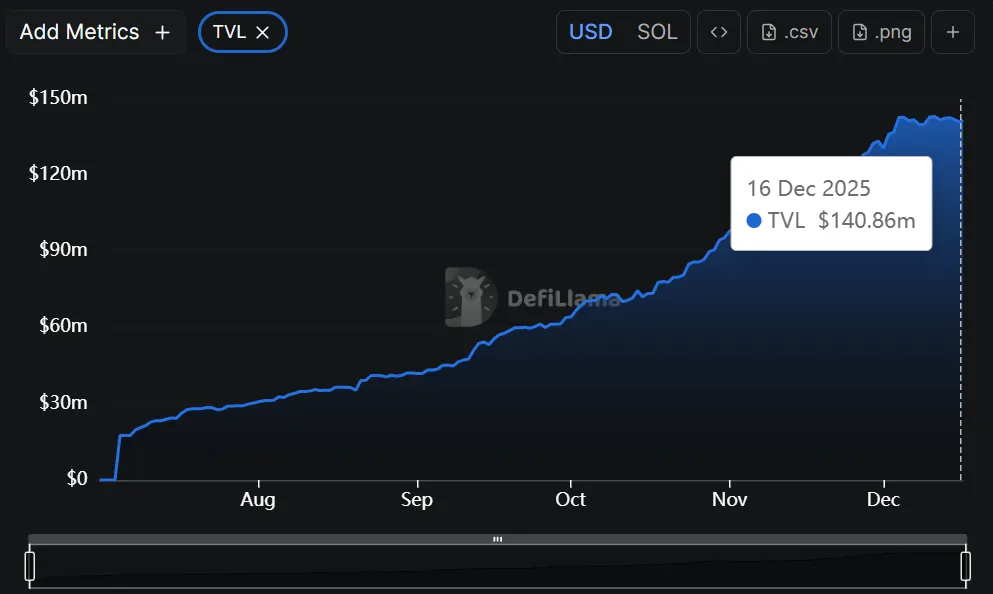
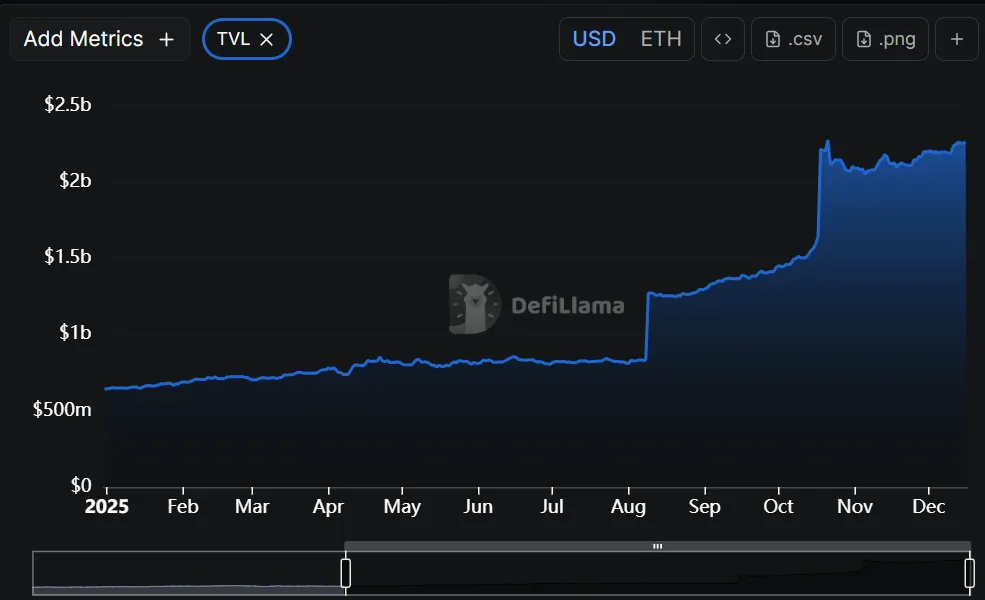
XStocks - fully-backed tokenised equities - grew from under $20 million in early July to over $140 million by December. More than 600% in five months, making it one of the fastest-growing asset classes across all of DeFi. Adoption was anchored in fundamentals institutions could actually trust: 1:1 custodial backing by regulated custodians, continuous 24/7 market access letting participants react to global events instantly, and liquidity profiles that consistently outperformed synthetic equivalents. Then Tether Gold (XAUt) delivered different proof - commodity tokenisation at scale, TVL growing more than 249% over 2025 and ending the year above $2.25 billion.
RWA protocol TVL 2025 (DefiLlama). The steady, non-cyclical climb from $7.5B to $16.5B reflects institutional allocation patterns - deliberate, measured, and uncorrelated with speculative market surges.
XStocks TVL (DefiLlama). Tokenised equities went from near zero in July to $140.86M by December - over 600% growth in five months, anchored by regulated custodial backing.
Tether Gold TVL (DefiLlama). XAUt grew 249%+ across 2025, closing above $2.25B - commodity tokenisation at institutional scale with deep, verifiable on-chain liquidity.
Stablecoins - The Macro Liquidity Engine Behind the Rebound
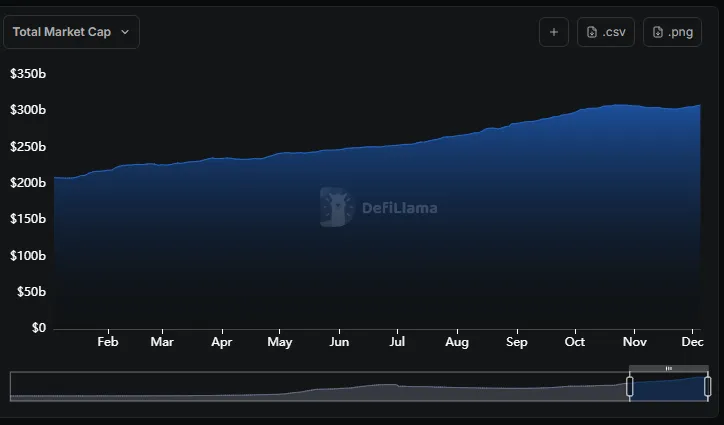
Nothing shaped the DeFi TVL recovery in 2025 more than stablecoins. The asset class crossed $300 billion in market cap, creating the deepest on-chain liquidity pool DeFi has ever had access to. But the headline number isn't the interesting part. What matters is how that expanded supply flowed back into DeFi protocols and basically restarted the system's liquidity engine across every major category.
Lending protocols felt it first and hardest: higher stablecoin supply translated directly into deeper borrowing liquidity, pushing lending TVL back to pre-contraction levels by mid-year. Perpetual DEXs benefited too - more stablecoins circulating on L2s meant traders could open larger positions and maintain collateral buffers, creating a self-reinforcing loop. More stablecoins, more trading collateral, more capital locked, higher TVL. Cross-chain bridges regained relevance as stablecoins started flowing between L2s and appchains in serious volumes. USDe, the synthetic yield-linked stablecoin, grew exponentially and redistributed liquidity across multiple ecosystems while driving demand for leveraged basis trades and yield farming across DeFi's core protocols. By Q3, stablecoins had firmly become DeFi's "money layer" - the base asset sustaining lending markets, powering perpetual DEX activity, enabling RWA growth, and fuelling cross-chain mobility.
Stablecoin total market cap 2025 (DefiLlama). The uninterrupted climb from ~$200B to $300B+ reflects not speculative demand but structural growth in on-chain financial activity - each incremental billion deepening DeFi's liquidity foundation.
Why this recovery was different: The 2025 rebound was not hype-driven. Protocols earned real revenue - staking, lending spreads, basis trades. Infrastructure got materially better: Layer 2 networks, modular execution layers, improved bridges creating safe and efficient capital pathways. A robust stablecoin economy added stability underneath it all. Real-world collateral brought credibility. Together, these forces built a healthier, more diversified DeFi ecosystem than anything that existed before the 2022 blowup. And that is the point worth remembering.
What This Renaissance Means Going Forward
Trend 01
Tokenised Assets as Core Collateral
Tokenised treasuries, equities, and commodities are on track to become foundational collateral across lending markets - providing steady, non-cyclical yield streams. Regulated backing and predictable cash flows anchor DeFi's stability the same way government securities anchor traditional finance. The parallel is almost exact.
Trend 02
Derivatives Infrastructure Dominates Volume
Perpetual DEX ecosystems led by Hyperliquid, Aster, and Plasma are increasingly dominating on-chain trading activity. As liquidity deepens and execution latency improves, these venues pull in institutional traders who want the transparency and resilience that centralised exchanges just cannot guarantee. FTX taught everyone that lesson the hard way.
Trend 03
Stablecoins as Global Settlement Rails
Stablecoins are transitioning from trading instruments into full-scale financial rails - powering cross-border transfers, remittances, and commerce. Speed, low cost, global accessibility. They're positioned to become the de facto settlement medium for the digital economy, potentially displacing SWIFT for every use case where speed and cost actually matter. And that is a very large number of use cases.
Trend 04
Ethereum Settles, L2s Execute
DeFi is increasingly operating on a two-tier model. Ethereum as the neutral, secure settlement layer with institutional-grade trust. High-throughput Layer 2 networks handling execution and user-facing activity at mass-market scale. This gives you both things at once - the credibility institutions demand and the performance everyday users need. It's an elegant split once you see it working.
8 Buying & Storing Altcoins
Buying altcoins is the easy part. The security decisions around storage - that's where most retail investors make costly mistakes. Before you buy anything, decide where it will live. And understand exactly what that storage decision means for your risk exposure, because the differences are not subtle.
🏛️Centralised Exchange
CEX Custody (Coinbase, Kraken, Binance)
How to buyDeposit fiat, trade for altcoin
Key controlsKYC required, full identity verification
Custody modelExchange holds private key - you hold an IOU
ConvenienceHigh - simple interface, fiat on/off ramp
RiskExchange insolvency, hack, or regulatory freeze
Best forActive traders, small positions, short-term holds
🔑Self-Custody
Non-Custodial Wallet (MetaMask, Ledger)
How to buyDEX swap (Uniswap) or transfer from CEX
Key controlsYou control the private key and seed phrase
Custody modelTrue ownership - no counterparty between you and your assets
ConvenienceMedium - requires gas fee management
RiskLost seed phrase = permanent loss. No recovery option.
Best forLong-term holds, DeFi participation, hardware wallet users
Mt. Gox, FTX, Celsius, Voyager. These are not edge cases. They are a pattern. Four major custodians failed in the past decade, costing users billions. And every single one of them looked healthy right up until the moment they weren't. No exchange - however large, however regulated - is immune to insolvency, hack, or regulatory seizure. For any position you plan to hold more than a few weeks, self-custody via a hardware wallet is the minimum acceptable security standard. Not a nice-to-have. The minimum.
9 How to Research Altcoins - A Practical Framework
With over 10,000 altcoins out there, the quality of your research process matters more than any single project pick. This framework mirrors what institutional researchers apply before allocating capital. Use it on every project before you buy. Every single one. No matter how compelling the narrative sounds - especially when the narrative sounds compelling.
01
Read the Whitepaper - Understand the Problem Being Solved
Every serious project publishes a technical whitepaper explaining its architecture, consensus mechanism, and token design. Read it. Actually read it. If you can't understand the problem the project claims to solve, or if the problem doesn't actually need a blockchain to solve it, that tells you something important. Projects with vague value propositions tend to have vague token value too. Not always. But often enough to treat it as a signal.
02
Evaluate the Team - Identity, Track Record, Commitment
Who are the founders and developers? Publicly identified? What have they shipped before? Anonymous teams aren't automatically a red flag in crypto, but they're a higher-risk signal that requires stronger compensation in protocol design quality. Look for advisors with real backgrounds, not just name-dropping of people who gave a one-line endorsement. And check GitHub commit activity. A project whose developers stopped committing code six months ago is already dying regardless of what the price chart says.
03
Analyse Tokenomics - Supply, Distribution, and Incentive Alignment
This is the most overlooked area of altcoin research and the source of the most preventable losses. Look at total supply, circulating supply, emission schedule. Projects where insiders (team + investors) hold more than 30% of supply with short vesting periods? Structural sell pressure is baked in from day one. Ask whether the token has genuine utility in the ecosystem or if it only exists for speculation. Inflationary tokens need continuous demand growth just to maintain price. Most projects can't sustain that. Most don't even come close.
Price is an opinion. On-chain data is evidence. For DeFi protocols, TVL measures the scale of economic activity actually running through the smart contracts. For L1 chains, daily active users and transaction volumes indicate real adoption. Rising TVL with stable or rising token price? Healthy signal. Falling TVL with rising price? That disconnect is worth investigating - usually means speculative capital is outpacing real usage, and that gap eventually corrects. Sometimes violently. Tools worth using: DeFiLlama, Token Terminal, Messari, Dune Analytics.
05
Assess Community and Governance - Decentralisation in Practice
Community is a project's most durable competitive advantage. Ethereum survived multiple existential crises because its developer community was broad enough to route around any single point of failure. Check Discord, forums, governance proposals. Are governance votes genuinely contested, or rubber-stamped? Growing community or stagnant? Here is the uncomfortable truth: projects where one team or one address controls a majority of governance tokens are structurally centralised. It doesn't matter what the marketing page says.
06
Map the Competitive Landscape - Who Are the Alternatives?
No project exists in a vacuum. Understand what it competes with, why someone would choose it over alternatives, and whether the claimed advantages are genuine or just marketing. In DeFi specifically, composability means protocols build on top of each other - so understanding where a protocol sits in the ecosystem stack matters as much as evaluating the protocol itself. A DEX that depends on a single stablecoin's liquidity inherits every risk that stablecoin carries. People forget this until they can't.
Altcoin Season - Reading the Macro Cycle
Altcoin season is when capital rotates from Bitcoin into altcoins at scale, producing periods where many altcoins outperform Bitcoin by wide margins. The 2017 and 2021 cycles both featured altcoin seasons so broad that even mediocre projects - genuinely bad ideas, some of them - posted triple-digit returns. Understanding the signals helps you position correctly. And more importantly, helps you avoid holding altcoins through the correction that always follows. Always.
Altcoin Season Indicator
Bitcoin SeasonNeutralAltcoin Season
Bitcoin dominance declining below 45% - capital rotating into altcoins
Rising trading volume across smaller-cap altcoins and DeFi tokens
Media narrative shifting from "Bitcoin ETF" to "DeFi," "NFTs," or "L2s"
75%+ of top 100 altcoins outperforming Bitcoin over 90 days
10 Risks & Pitfalls - What Most Investors Learn Too Late
The altcoin and DeFi space has produced some of the largest percentage returns of any asset class in history. Also some of the largest losses. Those two facts coexist. The risk register below covers the specific, named risks that experienced investors actually watch for - not generic "crypto is volatile" warnings, but the concrete failure modes that have destroyed real portfolios belonging to real people.
Smart Contract ExploitHigh Impact
If the code has a bug, someone will find it and exploit it - often within hours of discovery. Unlike a bank hack, there's no FDIC insurance. No reversal mechanism. No legal recourse against an autonomous contract. The Ronin Bridge ($625M), Poly Network ($611M), and dozens of other exploits have collectively drained billions. Verify that a protocol has been audited by multiple reputable security firms before depositing any meaningful capital. Not one audit. Multiple.
Rug Pull / Exit ScamHigh Impact
Anonymous teams raise liquidity, attract retail capital through aggressive yield promises, then drain the treasury or yank the liquidity. Token goes to zero overnight. The ICO era produced thousands of these, and they still happen regularly in newer, unaudited projects. Warning signs to actually watch for: anonymous teams, no code audit, yield promises in the hundreds of percent APY for brand-new protocols, and locked liquidity periods that expire suspiciously soon after launch. If it looks too good to be true in crypto, it is almost always too good to be true.
Impermanent LossMedium Impact
Specific to liquidity providers in AMM DEXs. When the relative price of deposited assets diverges significantly, LPs end up with a less valuable position than if they'd just held the assets and done nothing. The "loss" is impermanent in theory - reverses if prices return to entry ratios. In practice, most volatile trading pairs experience permanent divergence, making the name a bit misleading. Worst in pairs involving highly volatile assets. Least significant in stablecoin pairs where the whole point is that prices stay close together.
Stablecoin DepegMedium Impact
Stablecoins are DeFi's liquidity backbone. When they fail, they take entire ecosystems down with them. Terra/LUNA's algorithmic stablecoin UST depegged in May 2022, erasing roughly $40 billion in market value in 72 hours and triggering contagion across multiple DeFi protocols. Even USDC - which people thought was as safe as it gets - briefly depegged to $0.87 during the March 2023 Silicon Valley Bank collapse when $3.3 billion in Circle's reserves got temporarily frozen. Stablecoin risk is systemic. It affects everyone using the same liquidity pools, whether they realize it or not.
Regulatory ActionMedium Impact
The SEC went after Ripple (XRP), Coinbase, Binance, and numerous DeFi protocols - and proved that regulatory risk is real and deeply asymmetric. One enforcement notice can drop a token 50%+ in hours regardless of the project's technical merits. The EU's MiCA framework provided some clarity for European participants, but US regulatory posture remains contested and unpredictable. Projects designed around regulatory arbitrage carry structural long-term risk that no amount of technical quality can mitigate. Regulation doesn't care about your code quality.
Narrative ExhaustionManageable
Tons of altcoins get priced on narrative long before they have meaningful adoption. When the narrative shifts - DeFi summer ends, NFT enthusiasm fades, a new L1 captures developer attention - tokens priced on future expectations retrace to fundamentals fast. Projects that survive narrative cycles have real TVL, real users, real revenue. Everything else is just beta to whatever story the market is telling itself this quarter. On-chain metrics give you earlier warning than price charts when a narrative is losing substance. Pay attention to them.
★ Top Altcoins in 2025 - The Established Tier
These five altcoins represent the most established layer of the non-Bitcoin crypto market. Multi-year track records. Meaningful institutional adoption. The broadest developer ecosystems in the space. They carry significantly more risk than Bitcoin but meaningfully less risk than the broader altcoin market. If you're going to start somewhere beyond Bitcoin, this is where most serious allocators begin.
#
Project
Primary Use Case
Why It Matters
1
Ethereum (ETH)
Smart contract platform
Home to the bulk of DeFi TVL, NFT infrastructure, and institutional token issuance. ETF approval in 2024 plus the Proof of Stake transition cemented ETH as the institutional on-ramp to the broader crypto ecosystem.
2
Solana (SOL)
High-performance L1
Processing over 65,000 transactions per second at sub-cent fees. Solana's recovery from the FTX collapse (which wiped 97% of its price) was one of the more remarkable comebacks in crypto. Rebuilt a genuine developer ecosystem and now offers the fastest consumer-facing transaction experience in the space.
3
Cardano (ADA)
Research-driven L1
Built by academic researchers using formal verification methods. Slower to develop than competitors - intentionally so. Favoured in markets where regulatory rigour and academic credibility carry weight. Has meaningful presence in emerging market financial infrastructure projects.
4
Polkadot (DOT)
Interoperability protocol
Founded by Ethereum co-founder Gavin Wood. Lets separate blockchains (parachains) communicate and share security, tackling the fragmentation problem in multi-chain crypto. The vision - a connected web of specialised blockchains - has pulled in significant institutional developer interest.
5
Chainlink (LINK)
Decentralised oracle network
Smart contracts are closed systems - they can't access real-world data without an oracle feeding it in. Chainlink dominates this space, supplying price data, sports results, weather, financial data to thousands of smart contracts. As DeFi matures and RWA tokenisation expands, Chainlink's position as the data bridge between on-chain and off-chain worlds becomes increasingly critical. Hard to overstate how much depends on this one piece of infrastructure.
? Frequently Asked Questions
What is the difference between a coin and a token?
A coin is the native asset of its own independent blockchain. ETH on Ethereum, SOL on Solana, ADA on Cardano. A token gets issued on top of an existing blockchain using smart contracts - USDC on Ethereum, UNI on Ethereum. Why does the distinction matter practically? Because tokens depend entirely on the health of their host blockchain and require that chain's native coin to pay transaction fees. Ethereum gets congested? Every single Ethereum token gets affected regardless of how good the individual project is.
Are altcoins riskier than Bitcoin?
As a category? Yes, significantly. Bitcoin has the broadest institutional adoption, longest track record, clearest regulatory classification, and deepest liquidity. Most altcoins have shorter histories, smaller communities, more uncertain regulatory status, and less proven tech. Now - the risk is not uniform. Ethereum carries far lower risk than some freshly launched DeFi token. But as a group, altcoins amplify both the upside and the downside compared to Bitcoin. That's the deal you're making when you venture beyond BTC.
What is Total Value Locked (TVL) and why does it matter?
TVL measures the total dollar value of assets deposited in a DeFi protocol's smart contracts at any given moment. Closest thing DeFi has to "assets under management" in traditional finance - a rough gauge of scale, user trust, and economic activity. Rising TVL with genuine user adoption is a good sign. TVL pumped up by aggressive token incentives (yield farming) that vanish when the incentives end? Not so much. Always look at the ratio of TVL to the protocol's own market cap (price-to-TVL). That gives you a sense of whether the market is pricing the economic activity appropriately or just riding a narrative.
What is yield farming and how does it work?
Yield farming means deploying crypto assets across DeFi protocols to maximise returns. Basic version: deposit USDC into a lending protocol, earn interest from borrowers. More complex version: deposit assets as liquidity into a DEX, earn trading fees plus governance token rewards, sell those reward tokens for more USDC, deposit again. Returns range from 3-5% APY (low-risk stablecoin lending) all the way to 200%+ APY (new protocols with aggressive token incentives, carrying matching smart contract and rug pull risk). Golden rule: never chase the highest number without understanding where the yield comes from. If you can't explain it, you are the yield.
Do I need to understand code to participate in DeFi?
No. Modern dApp interfaces make DeFi accessible without coding skills. But understanding what the code is doing at a conceptual level - even without reading Solidity - is strongly recommended before you deposit real money. At minimum you need to know: what the protocol does, how it handles liquidations, what happens to your deposit if the protocol gets exploited, and whether it has been audited. There's no customer service line in DeFi. No deposit insurance. Understanding the mechanics before you interact is the only protection you get.
What is an altcoin season and how do I know when we're in one?
Altcoin season is when capital rotates out of Bitcoin into altcoins at scale, causing altcoins to broadly outperform BTC. Historical signals to watch: Bitcoin dominance (percentage of total crypto market cap in BTC) dropping below 45%, strong rallies in Ethereum and major L1s pulling the broader market up, rising DEX volumes, media attention pivoting from "Bitcoin ETF" to "DeFi" or "L2s" or whatever the new narrative is. The Altcoin Season Index tracks the percentage of top-100 altcoins outperforming Bitcoin over 90 days. Reading above 75% is the conventional threshold for calling it an altcoin season.
Key Takeaways
Altcoins are not Bitcoin alternatives - they are a separate asset class entirely. Different functions (smart contracts, DeFi, governance, payments), different research framework than Bitcoin's store-of-value thesis. Treat them accordingly.
DeFi is a genuine architectural shift in finance - from trust-based intermediaries to verification-based code. $178B+ TVL at peak was not retail speculation. That was institutional-scale adoption testing real infrastructure.
Categories matter more than individual project names. A governance token, a stablecoin, and a meme coin have completely different value drivers, risk profiles, and failure modes. Always categorise first, then evaluate.
On-chain data beats price as a signal. TVL, daily active users, protocol revenue, GitHub activity - these tell you what is actually happening inside a project. Price tells you what other speculators currently believe. Start with the data, not the chart.
Self-custody is non-negotiable for meaningful holdings. Every major custodial failure - Mt. Gox, Celsius, FTX - was preceded by a period when the custodian looked perfectly healthy. Hardware wallets and private key control. That's the only reliable answer.
Risk management separates long-term participants from casualties. Altcoins offer higher upside than Bitcoin but demand strict position sizing, genuine understanding of what you hold, and a clear plan for both the bull and bear scenario before you buy anything.
RWA (Real World Assets) is not hype - it's the institutional adoption vector. Tokenised US Treasuries, private credit, real estate moving on-chain. This is how traditional finance integrates with DeFi infrastructure. And it is likely the next major growth driver for the entire altcoin ecosystem.
PolyMarket Investment, Research Team, December 2025