This past July, America broke its electricity demand record twice in two days, hitting nearly 760 gigawatts at peak - enough to power every home in Texas sixty times over. The grid held. Barely. And the record stands only until the next heat dome, the next cluster of AI data centers coming online in Northern Virginia, or the next semiconductor fab that breaks ground in Arizona and needs 500 megawatts before it pours concrete.
While the investment world debates NVIDIA's forward P/E and the AI chip arms race, the most consequential investment story of this decade is happening in the background, mostly ignored: the wholesale reconstruction of America's electrical infrastructure. The grid that powers every AI data center, every EV charging station, every reshored factory - is on average over 40 years old and was designed for a world where electricity demand was flat, predictable, and growing at roughly 0% per year. That world ended around 2022. What replaced it is a demand environment nobody in utility planning had in their models.
The Edison Electric Institute - which represents investor-owned utilities - reports that the industry invested a record $178 billion in the grid in 2024. That was the 13th consecutive year of record spending. And the next five years will require more than $1.1 trillion in total. This is not a cyclical blip. This is a structural transformation, and the investment opportunities embedded in it are some of the most durable I've seen in any sector.
The Demand Shock: How Flat Became Vertical
For almost twenty years - from roughly 2005 through 2020 - U.S. electricity demand was essentially flat. Efficiency gains in appliances and industrial equipment kept total consumption stable even as the economy grew. Utility planners built their capital allocation models on that assumption. They planned capacity for more of the same. They were wrong in a way that will cost hundreds of billions to correct.
The break came in stages. First came the data centers - which seemed manageable at first, just another industrial load. Then the AI acceleration of 2022-2023 changed the math entirely. AI training clusters and inference infrastructure are extraordinarily power-hungry. An H100 GPU cluster running at capacity draws power continuously, unlike a server farm that load-balances and sleeps. Data centers consumed roughly 180 terawatt-hours of power in 2024. By the end of the decade, that number is expected to roughly double. In Texas and the Mid-Atlantic - where data center clusters are dense - demand is already rising 10% or more per year. Not 10% total. Ten percent annually, compounding.
Layer on top of this the reshoring of American manufacturing - semiconductor fabs, battery plants, pharmaceutical facilities - each of which requires industrial-scale power, and the electrification of transportation, and you get a demand trajectory that no grid built in 1975 was designed to accommodate. The EIA now forecasts nationwide demand growing at 2-3% annually through 2050, revised sharply upward from the previous 1.6% forecast. And Wood Mackenzie's analysis of the US market is even more pointed: power prices across most markets are expected to rise 10-50% above previous forecasts as the combination of stronger demand, higher commodity costs, and thermal generation expansion pressures supply.
The Virginia Precedent
Northern Virginia hosts the largest concentration of data centers on the planet. Dominion Energy - the dominant utility - is warning that residential electricity prices in the state could rise an additional 25% by 2030, on top of the 30%+ increase already absorbed since 2020. This is what "AI infrastructure demand" looks like in practice, at the distribution grid level where families actually feel it. The cost allocation debate - should data centers pay their full infrastructure share, or should that cost be spread to residential ratepayers? - is one of the most politically charged regulatory fights in the utility sector right now, and its resolution will shape the investment case for utilities operating in high-density data center markets.
The $178 Billion Year - and Why It Still Isn't Enough
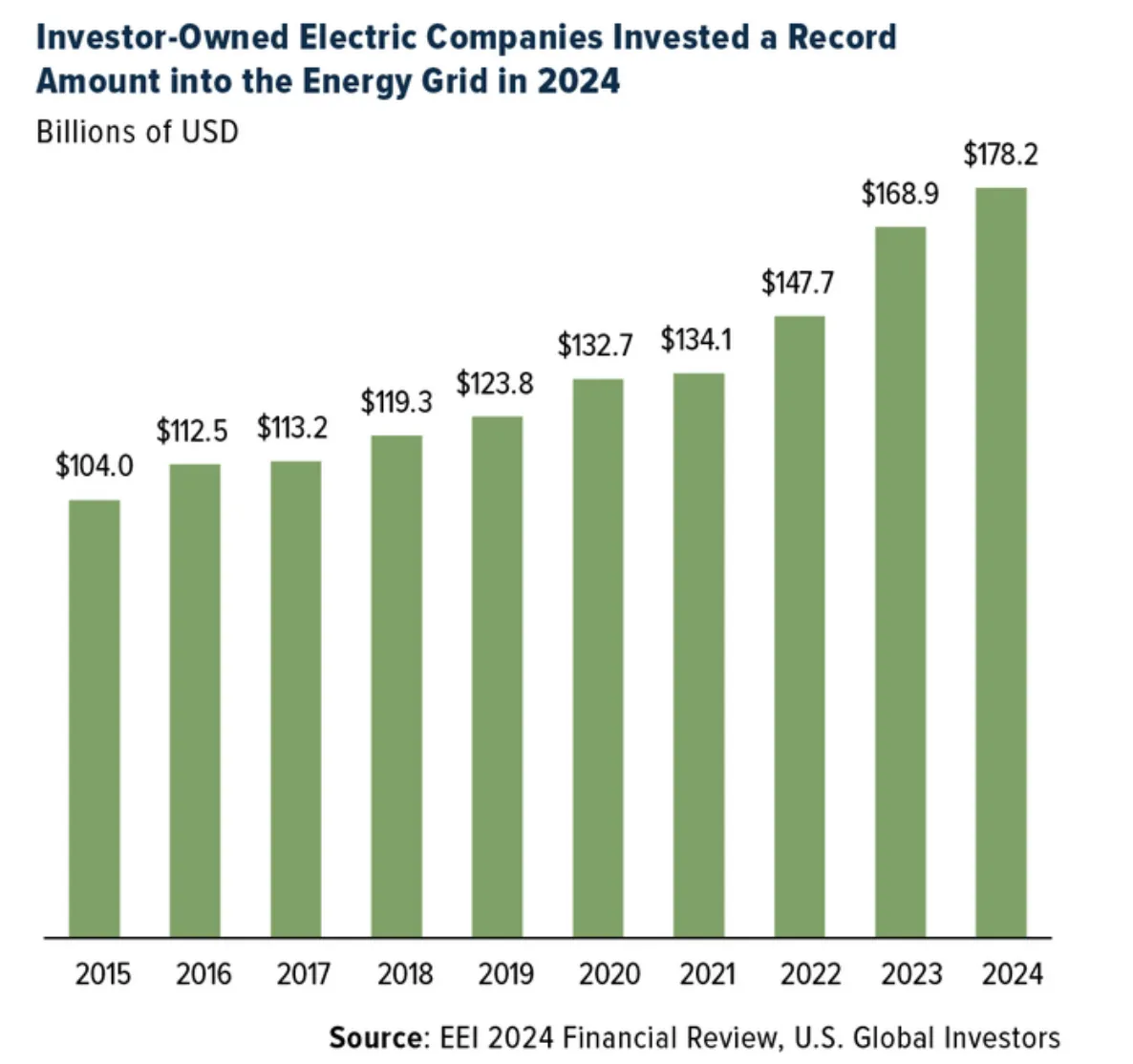
The chart above tells one version of the story. The compound growth in grid investment over the past decade has been genuinely impressive - a near-doubling from $104 billion in 2015 to $178.2 billion in 2024. Thirteen consecutive record years is not a trend; it is a structural reality. But even this trajectory may be insufficient for what the grid needs to absorb over the next ten years.
Here is the problem: building new grid capacity is not like building a factory. You don't break ground and have output in 18 months. Large power transformers - the massive components that step voltage up and down across regional networks - take 12-18 months to manufacture and another 6-12 months to install and commission. Before the AI surge, lead times were already stretching. Now they are extraordinary. Hitachi Energy's recent announcement of a $457 million transformer manufacturing facility in South Boston, Virginia - which will become the largest domestic producer of large power transformers in the United States - is specifically a response to this bottleneck. The facility won't begin operations until 2028. Three years away. In a market where demand is rising now.
COVID-19 severely disrupted the global transformer supply chain, depleting strategic inventories that take years to rebuild. The situation has improved but not resolved. When a grid operator in PJM (which manages power for 13 states and DC) anticipates peak demand reaching 154,000 MW - potentially surging to 166,000 MW under extreme heat scenarios - and is simultaneously waiting 18 months for replacement components, the operational risk is not theoretical. It is an engineering problem with a political price tag.
The Physics of the Grid: Why This Is Hard
To understand why the grid modernization challenge is genuinely difficult - and not simply a matter of writing checks - it helps to understand what the grid is actually managing. This is not software infrastructure. You cannot add capacity by spinning up a new cloud region. Electricity has to be generated and consumed in near-perfect balance, millisecond by millisecond, across a network spanning thousands of miles and hundreds of generators. The margin for error is measured in fractions of a hertz.
The fundamental constraint is storage. Electricity remains extraordinarily expensive to store relative to its value. This is the reason grid operators spend enormous resources on demand forecasting - because minor mispredictions don't result in error messages, they result in brownouts. Tokyo's grid operator maintains real-time demand forecasts that update minute-by-minute, tracking behavior patterns as predictable as a daily tide: demand rises as people wake, peaks in late afternoon when residential air conditioning combines with commercial loads, then falls overnight. The gap between the daily minimum - base load - and the peak is the challenge that has shaped the economics of the power sector for a century.
Always On
Nuclear, coal, geothermal, hydro - sources that run continuously because their economics and physics demand it. Nuclear is the most capital-efficient: extremely low marginal fuel costs, but thermal inertia means it cannot ramp quickly. Coal can modulate somewhat but essentially runs or doesn't. These sources form the floor under every grid's operations.
Supply Meets Demand
Natural gas, solar, wind - the flexible layer that fills the gap between base load and whatever demand is doing. Gas can ramp in minutes; solar and wind follow the sun and atmosphere. Battery storage is rapidly becoming part of this layer, with CAISO (California's grid) already operating 11 GW of battery capacity that can shift solar generation into evening peak hours.
Expensive Insurance
Gas turbines (essentially jet engines generating electricity) that sit idle for most of the year, economically justified by keeping the lights on during annual peak demand windows. They have the worst economics of any generator - high fuel cost, low utilization - but the market needs them because demand peaks are real. The economic equivalents of peakers are virtual power plants: software and contracts that achieve the same load-shedding without the steel.
The reason this matters for investors is that the composition of the generation mix is changing faster than at any point in grid history. Battery storage costs have fallen 85% over the past decade. Solar is now the cheapest source of new electricity generation - not just cheaper than coal, but cheaper than any fossil fuel alternative, with or without subsidies. This is permanently altering the economics of every layer of the generation stack.
The Renewable Reality vs. the Political Fight
I want to be direct about the political noise around renewable energy, because it has real investment implications. President Trump has described offshore wind as "STUPID AND UGLY WINDMILLS" and attributed high electricity prices to green energy projects. This makes for memorable Truth Social content. It does not survive contact with the data.
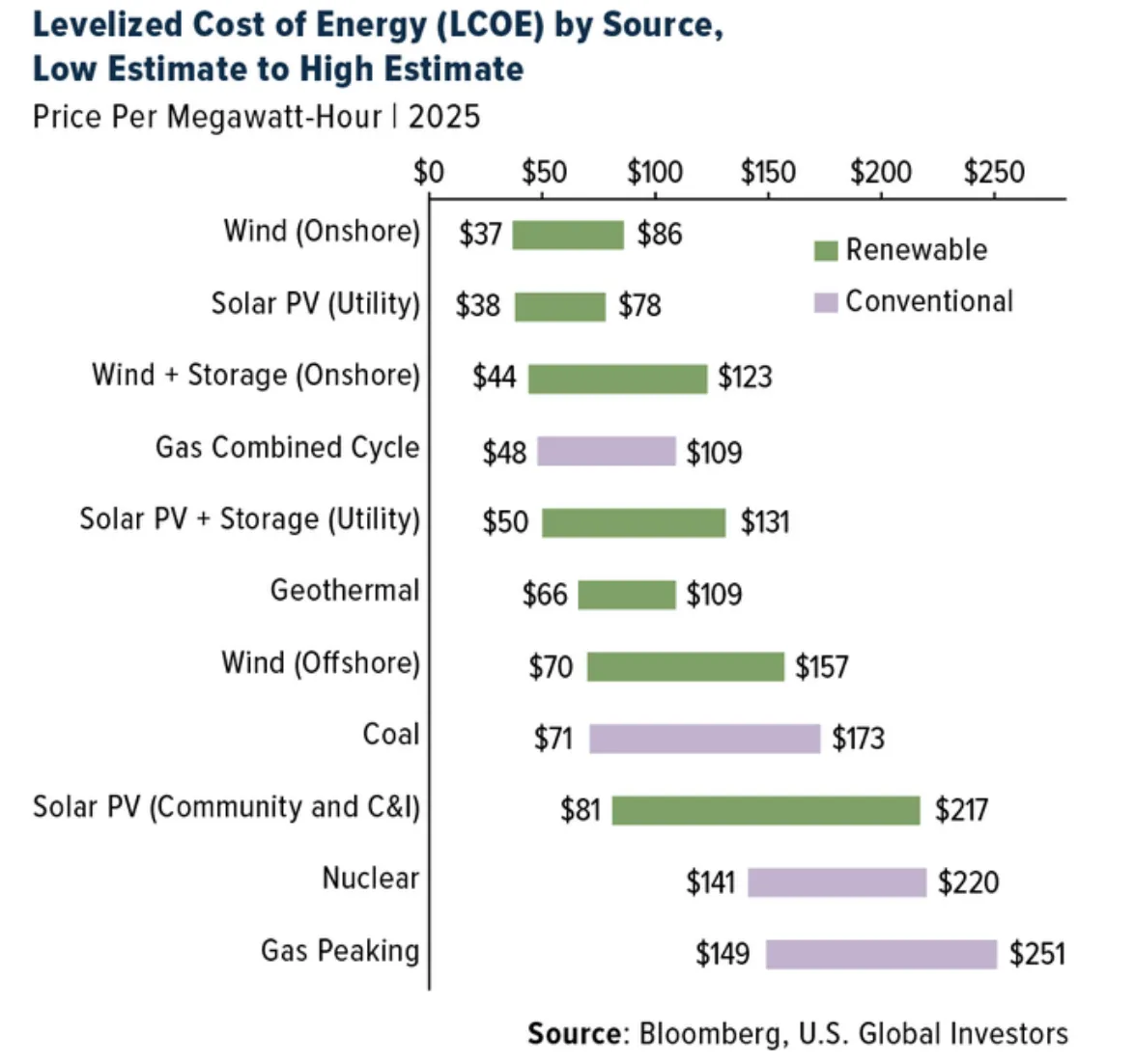
In New Jersey - the state specifically cited in those posts - offshore wind projects never got built. Wind contributes less than 1% of the state's electricity. The actual drivers of higher bills are rising natural gas prices (up nearly 14% year-over-year as of summer 2025), the cost of upgrading infrastructure that should have been replaced a decade ago, and surging industrial demand from data centers. The LCOE chart above makes the underlying economics clear without requiring any political interpretation: utility-scale solar delivers power at $38-78 per megawatt-hour. A new gas peaker - the alternative the political narrative implicitly defends - costs $149-251 per megawatt-hour. Three to six times more expensive. Private equity and institutional capital understand this, which is why BloombergNEF reports that the majority of new energy investments globally are flowing into renewables, not fossil fuels.
None of this means renewables solve everything. They require transmission buildout, storage, and backup - significant infrastructure investments that have their own timelines and costs. Wind development faces genuine regulatory headwinds under the current administration, with additions projected 17% lower by 2050 than previous forecasts. The cancellation of the $4.9 billion Grain Belt Express loan guarantee - an 800-mile transmission line that would have delivered wind power from Kansas to population centers - drew bipartisan criticism precisely because it removes infrastructure that would have improved grid reliability, not just expanded wind power. These are real setbacks with real costs.
But the long-run economics are not in doubt. By 2050, Wood Mackenzie projects clean energy will constitute 72% of US electricity generation. The Electric Power Research Institute projects that household energy spending will fall by more than a third in real terms by 2050 - as gasoline spending (currently ~$3,000 per household annually) shifts to electricity, and electricity gets cheaper as renewables penetrate the grid. The pain is front-loaded. The payoff is structural.
The National Security Layer
There is a dimension of the grid investment story that rarely gets adequate attention in financial analysis: the supply chain vulnerability. The United States currently relies entirely on imported capacitor film - a critical component of power grid stability hardware - with no domestic manufacturing capability. This is one component among many. Large power transformers, the backbone of long-distance transmission, are manufactured almost exclusively in Asia and Europe, with lead times that can exceed two years for specialized units. The Department of Energy has warned explicitly that America lacks the supply chain for true energy independence.
The Supply Chain Chokepoint
In early 2025, Ontario threatened a 25% surcharge on electricity exports to several U.S. states in retaliation for tariffs - a move that was ultimately suspended. But the episode exposed how quickly energy interdependence can become a geopolitical pressure point. More structurally concerning: imported grid hardware potentially gives foreign manufacturers - and potentially foreign governments - insight into critical infrastructure configurations. The Forbes Communications Council has framed it plainly: the grid is America's biggest national security vulnerability that the public isn't talking about. China's capacity to disrupt America's supply of grid materials grows with every year of manufacturing dependence.
This is why Hitachi Energy's $1 billion U.S. investment announcement - part of a $9 billion global strategy - carries significance beyond the corporate press release. The Virginia transformer factory is specifically designed to onshore a critical supply chain that currently has no domestic equivalent at scale. CEO Andreas Schierenbeck's framing was precise: "Bringing production of large power transformers to the U.S. is critical to building a strong domestic supply chain for the U.S. economy and reducing production bottlenecks." This is a company making a multi-decade bet on U.S. energy infrastructure spending.
Texas Senate Bill 6 - which grants ERCOT the authority to require large power users (data centers, crypto mines, industrial plants consuming 75 MW or more) to switch to backup power or shut down during grid emergencies - reflects the same underlying reality at the state policy level. When a single data center cluster can stress an entire regional grid, the governance framework for power access becomes a strategic question, not just a regulatory one.
The Investment Framework: Who Benefits
The grid modernization story translates into a broad investment opportunity set, but the quality of opportunity varies considerably by sub-sector. In my view, the most interesting positions are not the obvious ones.
| Category | Key Names | Investment Logic | Key Risk |
|---|---|---|---|
| Large Utilities (Regulated) | NEE ($153B), VST, DUK, SO | Regulated returns on massive capex, 94% raised dividends in 2024, AI demand directly boosts rate base growth | Rate case outcomes, political pressure on cost recovery, rising interest rates |
| Grid Equipment & Transformers | Hitachi Energy (6501.T), ABB (ABBNY), Eaton (ETN) | Structural supply shortage; transformer lead times 18+ months; domestic buildout required; direct capex beneficiaries | Execution on new capacity; competition from Asian manufacturers at lower cost |
| Energy Storage | NEE (indirect), Enphase (ENPH), Bloom Energy (BE) | CAISO already at 11 GW battery storage; Asia Pacific storage revenues to grow from $14B to $184B by 2035; every renewable deployment drives storage demand | Policy reversals on storage incentives; technology competition; ENPH margin pressure from competition |
| Battery Materials | Albemarle (ALB), Panasonic (PCRHY), BYD (BYDDY) | Structural demand from grid storage, EVs, and backup power; domestic supply chain imperative creates policy tailwind | Lithium commodity cycle volatility; ALB notably weak YTD due to soft lithium prices despite strong long-term demand |
| Independent Power Producers | Vistra (VST), Talen Energy, Constellation (CEG) | Merchant power pricing rises 10-50% per Wood Mackenzie; nuclear assets command AI-driven contracted power premiums (Microsoft, Google) | Merchant price volatility; nuclear regulatory complexity; capex requirements for life extensions |
| Broad ETF | Utilities Select SPDR (XLU), iShares Global Clean Energy (ICLN) | Diversification across the full utility value chain; lower maintenance than stock-picking | Sector-level valuation risk; interest rate sensitivity for regulated utilities |
NextEra Energy - The Standard Bearer
NextEra Energy (NEE) at $153 billion in market capitalization is the largest publicly traded utility in the world and in my view the clearest expression of where the sector is heading. It is the world's largest wind and solar power generator, operates Florida Power & Light (one of the most reliable utilities in the country), and has a development pipeline that positions it to benefit from every major demand driver simultaneously: data centers, EV charging, manufacturing reshoring. The stock's historical performance has been outstanding for a "boring" utility - and 94% of utilities raised dividends in 2024, with payout ratios higher than any other US sector. In an environment of rising power demand and rising capex budgets, regulated utilities with strong rate bases are not boring. They are compounding machines with regulatory protection.
The Global Picture: Asia Leads, Europe Struggles
The U.S. grid story does not exist in isolation. Wood Mackenzie's 2025 global power market outlook frames the broader context: Asia Pacific is experiencing an investment boom of historic proportions, with generation investments projected at $3.9 trillion over the next decade - 44% higher than the previous ten years. Energy storage, in particular, is transitioning from niche technology to mainstream infrastructure, with storage revenues in Asia Pacific projected to surge from $14 billion in 2024 to $184 billion by 2035. The region drove 82% of worldwide power demand growth between 2015 and 2024. That structural weight is not diminishing.
Europe's picture is more complicated. Political commitment to decarbonisation remains strong, but permitting and grid connection bottlenecks continue to impede actual deployment. Offshore wind faces rising cost pressures. Demand growth is weakening as traditional industrial sectors face macroeconomic headwinds. The energy transition is happening in Europe, but slower and more expensively than originally planned. For global energy infrastructure investors, the return opportunity is currently weighted toward Asia Pacific and the U.S., not Europe.
Chile offers an interesting edge case in Latin America: a 16% renewable energy oversupply is projected by 2035 as solar buildout outpaces demand growth. Marginal power costs will fall 64% from $53/MWh to $19/MWh by 2040. For copper mining operations in the Atacama - which will consume 46 TWh of power by 2050 - cheap renewable energy fundamentally changes the cost structure. This is one of the cleaner ways to play the grid buildout story indirectly: copper miners and lithium producers in Chile whose energy costs will decline structurally even as global power prices rise.
The Three Risks Worth Taking Seriously
Grid Instability Events
PJM is anticipating peak demand reaching 154,000-166,000 MW under extreme scenarios. The Texas winter storm of 2021 demonstrated how quickly a stressed grid can fail catastrophically. As AI data centers add large, continuous loads to systems designed for residential fluctuation patterns, the probability of regional stress events - brownouts, rolling curtailments, emergency demand response - is rising. Texas SB6's curtailment authority is a policy response to a real engineering risk.
Policy Reversal on Renewables
The Trump administration's cancellation of the Grain Belt Express loan and hostility to offshore wind have real economic consequences. Wind project additions are already projected 17% lower by 2050 versus prior forecasts. If the regulatory environment for renewable interconnection worsens, utilities face higher all-in costs for meeting demand - costs that ultimately flow to ratepayers and compress margins. Policy risk is not symmetric: it can slow the transition but probably cannot reverse the underlying economics.
Interest Rate Sensitivity
Regulated utilities are effectively long-duration bonds with equity upside. A $1.1 trillion capex program financed at 6% interest rates looks very different from one financed at 4%. Rising rates compress utility valuations and make dividend yields less competitive relative to fixed income alternatives. The rate environment of 2022-2023 damaged utility stocks significantly. Any investor in regulated utilities must hold a view on where rates are going over a 5-year horizon.
"The grid is the foundation that the AI revolution is built on - and it is the most underpriced risk in the AI investment narrative. Investors pricing in the revenue growth of hyperscalers and chip designers are implicitly betting that the physical infrastructure powering their servers will scale on schedule. It will not scale on schedule without $1.1 trillion in capital investment, transformer factories that won't open until 2028, and regulatory frameworks that are only now beginning to acknowledge the problem. The constraint is real. The investment opportunity on the right side of that constraint - utilities, grid equipment, energy storage - is also real, and it is considerably cheaper than the AI stocks that depend on it."
Conclusion: Follow the Electrons
The EPRI's long-run projection is worth sitting with: by 2050, American household energy spending could fall by more than a third in real terms. The mechanism is counterintuitive but logical - as transportation electrifies, the $3,000 per household spent annually on gasoline shifts to electricity bills, and as renewables penetrate the generation mix, the marginal cost of electricity declines. The transition creates short-run pain (electricity bills up 5.5% in the past 12 months, and rising further in high-demand markets like Virginia) but long-run structural improvement.
For investors, the framework I keep returning to is simple: electricity demand in the United States is rising at the fastest pace in decades, driven by forces - AI, manufacturing reshoring, electrification - that are not cyclical. The grid serving that demand is old, underpowered, and dependent on imported components in ways that are increasingly recognized as a national security concern. The companies building its replacement - utilities executing record capex programs, equipment manufacturers onshoring transformer production, storage technology firms making battery economics work at grid scale - are collecting revenues and dividends that compound quietly while the financial press debates chip stocks.
Key Takeaways
America's grid investment will exceed $1.1 trillion over the next five years - driven by AI data center demand, manufacturing reshoring, and electrification of transport. The grid has not been built for this; modernization is not optional, it is existential for every industry that depends on reliable power.
Renewables are the cheapest new generation source at $0.04/kWh for utility solar, against $0.15-0.25/kWh for gas peakers. The economics are not political; they are a procurement reality that private capital has already internalized, regardless of what policy cycles do at the margins.
The most underappreciated positions are grid equipment manufacturers and regulated utilities with strong rate base growth. NextEra Energy is the sector's clearest expression of the long thesis. Hitachi Energy's transformer factory bet on domestic supply chain rebuilding is a decade-long structural play. Battery storage revenues in Asia Pacific alone will grow from $14 billion to $184 billion by 2035. The electrons lead. Follow them.
Research Desk, PolyMarkets Investment Strategies, September 5, 2025