There are events in stock market history that are categorically different from the operational or strategic risks that should determine a company's long-term value. A data breach is one such event. It is a compliance failure, a reputational shock, and a regulatory catalyst - but it is not, by itself, evidence that a company has lost its competitive moat, its pricing power, or the fundamental reasons millions of people keep coming back every single day.
Coupang is down approximately 50% from its 2025 highs as of this writing, and the proximate cause is clear: a data breach affecting 33 million users, the resignation of its founding CEO, and a wave of parliamentary hostility that made headlines across South Korea and beyond. The market's response was swift and severe. Ours is more measured - and more optimistic.
We believe the market has conflated the costs of a fixable compliance failure with the destruction of a business that is, by every operational measure, growing faster than its peers, defending a logistics moat that took a decade and several billion dollars to build, and expanding into a Taiwan market showing triple-digit growth acceleration. At $17–$19 per share, investors are paying approximately 0.8–0.9× forward EV/Sales for that business. Amazon traded at a comparable multiple only at its worst historical trough. That asymmetry is where this opportunity lives.
At a Glance & Conviction Score
Coupang is South Korea's dominant e-commerce and logistics platform. Think of it as Amazon, Instacart, DoorDash, and Prime Video wrapped into a single subscription - operating in one of the densest, most digitally sophisticated consumer markets in the world. The company commands approximately 40% of South Korea's online retail market, serves 24.7 million active customers, and has built a fulfillment network so pervasive that 70% of the Korean population lives within 7 miles of a Coupang warehouse. The following dashboard captures the company as it stands today, at a materially distressed valuation.
Thesis Conviction Score
The Coupang Model - Why This Business Is Defensible
Coupang is frequently - and correctly - described as the Amazon of South Korea. But that comparison undersells the depth of its competitive position. Amazon built its moat incrementally, fighting off well-resourced incumbents across a diverse geography over two decades. Coupang built its moat in a single small country with extraordinary population density, creating a network so tightly woven into daily Korean life that alternatives require genuine sacrifice on the part of consumers to use.
The WOW membership - Coupang's equivalent of Amazon Prime - is particularly telling. For approximately $7 per month, 14 million Korean households get free same-day or next-day delivery on millions of items, free delivery from Coupang Eats (food delivery), and ad-free access to Coupang Play (streaming). The bundle economics are formidable: this generates approximately $1.2 billion in near-pure-margin annual subscription revenue while simultaneously deepening customer dependency and driving higher order frequency. Newer customer cohorts are joining at higher spending levels and increasing their spend faster than prior cohorts - a classic sign of growing network utility.
Rocket Delivery Speed Moat
99% of orders fulfilled within 24 hours. Competitors like Naver (a marketplace aggregator with no proprietary logistics) fundamentally cannot replicate this - it would require a decade and billions in capital. Rocket Delivery is not a feature; it is a structural barrier.
99% <24h deliveryFulfillment Network Density
Over 100 fulfillment centers covering South Korea's high-density geography. 70% of the population lives within 7 miles of a Coupang fulfillment center - a spatial moat that makes Coupang the default, frictionless choice for daily commerce.
70% of Korea within 7 milesWOW Ecosystem Lock-In
14 million paying subscribers across shopping, food delivery, and streaming. The multi-product bundle creates switching costs - leaving Coupang means giving up delivery convenience, a food delivery service, and a streaming platform simultaneously. Churn is structurally low.
14M subscribers - ~$1.2B/yrData & AI-Driven Logistics
Years of delivery and purchasing data fuel demand forecasting, routing optimization, and inventory positioning that competitors cannot match without running the same volume through their own systems. AI automation is a stated driver of management's 10%+ EBITDA margin target.
10%+ EBITDA margin LT target"Active customers on the platform have more than doubled since end-2019, and newer cohorts not only shop at higher initial levels but increase their spending faster than older cohorts - a pattern that reflects a platform becoming more valuable over time, not less."
- Miller Value Partners, December 2025One competitive dynamic the market consistently underweights is the nature of Coupang's return policy. Customers with WOW memberships can leave return items at their front door and Coupang couriers pick them up - with no labels, no packaging requirement, no trip to the post office. This single feature has no parallel in Korean e-commerce and generates disproportionate loyalty among households making regular purchases. It sounds like a detail; it is actually a significant behavioral anchor.
The Data Breach - Sizing the Damage, Not the Fear
The facts of the breach deserve a clear-eyed reading - neither minimized nor inflated. In late 2025, a data breach attributed to a former employee who allegedly stole internal security credentials exposed the personal data of over 33 million Coupang users. The response was poorly managed: the breach went undetected for months, the mandatory 24-hour disclosure requirement was violated by more than a week, and founding CEO Bom Suk Kim's absence from a parliamentary hearing - compounded by an interim CEO's inability to address Korean lawmakers in Korean - triggered a public and political backlash that accelerated the stock's decline.
South Korea's Personal Information Protection Act (PIPA) allows fines of up to 3% of annual revenue for negligence in data protection. Regulatory investigations remain ongoing. Class action lawsuits from both U.S. shareholders and Korean users are active. The parallel case with SK Telecom - which faced a similar breach affecting over 20 million users and has already paid fines exceeding $90 million, with potential consumer compensation pushing exposure toward $1 billion - provides the most relevant benchmark for what Coupang faces.
Worst Case Financial Impact - What If Everything Goes Wrong?
Even in this worst case - which assumes the maximum regulatory penalty, full SK Telecom-scale consumer compensation, meaningful U.S. legal settlements, and the complete permanent loss of the approximately 2 million users who reportedly churned - the total is manageable. Coupang holds over $5 billion in cash, carries net cash of approximately $2.3 billion (cash exceeds debt), and generates over $1 billion in annual free cash flow. The company can fund a $2 billion adverse outcome without touching its growth investment programme or balance sheet integrity.
The probability of the absolute worst case materialising is also lower than the stock price implies. The company has already begun voluntary remediation, enhanced its cybersecurity infrastructure, and is cooperating with regulators - factors that have historically reduced penalties in similar cases. Management's stated position that only approximately 3,000 users were meaningfully affected by the breach (as distinct from those whose data was accessed) is still under regulatory review, but if confirmed, would dramatically reduce consumer compensation exposure.
The broader market context matters here too. J.P. Morgan, in a note following the initial breach disclosure, observed that Korean consumers have historically demonstrated limited sensitivity to data breach events in their ongoing use of dominant platforms. Morgan Stanley and Bank of America Securities both maintained Buy ratings with price targets of $35 and $38 respectively even after the breach became public - targets that still imply 80–100% upside from the current entry zone.
Growth Engines Beyond Korea
The Korea business is the engine, but the optionality elsewhere is what makes the current valuation genuinely compelling. Coupang's developing offerings - Taiwan, Farfetch/R.Lux, and Coupang Eats - are not peripheral experiments. They are bets on market structures where Coupang's core advantages are directly replicable.
Taiwan: The Thesis Within the Thesis
Coupang entered Taiwan with its Rocket Delivery model and WOW subscription bundle, targeting a market where the dominant player (Shopee Taiwan) currently takes several days for standard delivery. Coupang is delivering in under 24 hours for 99% of orders. The early data is striking: triple-digit revenue growth in Q3 2025 (the most recent quarter before the breach); ranking third in the Shopping category on Apple's App Store (ahead of Shopee, which ranked sixth); and an accelerating gap in Google Trends data showing Coupang's brand awareness closing on market leader Momo.
Taiwan's structural similarity to South Korea - comparable per capita GDP, similarly high population density at over 600 people per square kilometre (vs. 530 in Korea), and a digitally sophisticated consumer base - makes it the most natural replication of Coupang's playbook outside its home market. A base-case 20–25% market share in Taiwan would represent $4–6 billion in annual revenue, with margins potentially tracking toward Korea's mid-single-digit profile once the investment phase matures.
Advertising: The Underpenetrated Lever
Coupang does not break out advertising revenues, but estimates based on its GMV and product mix suggest ad revenue represents approximately 2% of GMV - versus Amazon's approximately 7%. The platform is structurally suited to advertising: 24.7 million active customers with rich purchase data, a WOW subscriber base with high purchase intent, and a growing third-party marketplace. Closing even half the gap to Amazon's ad monetisation rate on Coupang's current GMV would add roughly $1 billion in high-margin revenue - with no additional customers required.
R.Lux & Farfetch: Luxury Beauty as a Category Moat
Coupang acquired Farfetch in 2023 and launched R.Lux in late 2024, positioning itself in the premium and luxury fashion and beauty space. The Korean beauty and luxury market is large and structurally growing, driven by rising disposable income and the global cultural influence of Korean aesthetics. Olive Young, Korea's dominant beauty retailer, generates approximately $4 billion in annual revenue. Coupang's combination of Farfetch's global luxury brand relationships, R.Lux's elevated local positioning, and Rocket Delivery's convenience advantage creates a differentiated offering that standard beauty retailers cannot match.
Revenue Scenarios - FY2027 Projection
The following table models Coupang's revenue and earnings profile across three scenarios for FY2027. The base case reflects continuation of current growth trajectories with partial normalisation of the breach impact.
| Revenue Segment | Bear | Base | Bull |
|---|---|---|---|
| Revenue (USD Billions) | |||
| Korea Product Commerce | $27B | $31B | $36B |
| Taiwan Operations | $1.5B | $4B | $7B |
| Farfetch / R.Lux Luxury | $1.5B | $2.2B | $3.2B |
| Eats + Coupang Play + Other | $1.2B | $1.6B | $2.2B |
| Total Revenue | $31.2B | $38.8B | $48.4B |
| Earnings & Valuation | |||
| EBITDA Margin | 4% | 6.5% | 9% |
| EBITDA | $1.25B | $2.52B | $4.36B |
| EV / EBITDA Multiple Applied | 15× | 21× | 27× |
| Implied Share Price | $11–$14 | $29–$33 | $55–$65 |
The bear case multiple of 15× reflects a market that continues to apply a breach discount and sees limited Taiwan progress. Even in this scenario, the implied price of $11–$14 is contained by the company's net cash position and FCF generation. The base case - which reflects the most probable outcome - produces a price squarely within our target zone of $29–$34.
What Smart Money Is Doing
One of the most compelling features of the current setup is the behaviour of sophisticated institutional investors in the months surrounding the period of elevated regulatory scrutiny. While retail sentiment turned sharply negative - and the social media reaction in Korea was predictably hostile - professional capital has been systematically accumulating Coupang's shares. Institutional investors now collectively control approximately 83.72% of outstanding shares, and the recent filing data tells a clear directional story.
Most notably, RIT Capital Partners - a prestigious UK closed-end investment fund managed by the Rothschild family - has made Coupang its single largest portfolio position, with an $87M holding representing its largest single-equity concentration. RIT is not a momentum fund. It is a multi-asset, capital-preservation-first institution that has operated for over 50 years. When a fund of that profile makes a single equity its largest position, it is a meaningful signal worth investigating.
The pattern is consistent with what happens in high-quality businesses that experience sharp event-driven drawdowns: patient, long-duration capital uses the retail panic as a liquidity window. The Norges Bank position is particularly notable - Norway's sovereign wealth fund, which manages the assets of the Norwegian people on behalf of future generations, initiated a position worth nearly $600 million in the quarter before the breach became public. That is not a speculative bet; it is a structural assessment of long-term value.
"Coupang is the dominant and leading player in a large addressable market with numerous growth levers at a compelling price... CPNG trades at a forward EV/Sales multiple near a level that historically marked a bottom for Amazon."
- Miller Value Partners Portfolio Commentary, December 2025Consensus vs. Our View
The market's current narrative on Coupang can be distilled into five core assumptions, each of which we believe is either wrong in degree or wrong in direction. The table below maps where we diverge from consensus - and why the divergence matters for the price target.
| Assumption | Consensus / Bears Say | Our View |
|---|---|---|
| Data breach - existential threat? | Permanent brand destruction; customers will migrate to Naver and competitors en masse | A quantifiable, one-time cost event. Switching cost moat limits churn. 2M churned users vs. 24.7M active - less than 10% attrition in worst estimates |
| Regulatory risk magnitude | Maximum 3% fine ($1B+) virtually certain; business suspensions possible | Regulators are unlikely to suspend a platform that 100,000 employees and millions of merchants depend on. Fine is probable but manageable vs. $5B cash cushion |
| Taiwan - viable or money pit? | Expensive distraction; Shopee entrenched; losses will persist for years | Triple-digit growth acceleration. Structural advantage (24h delivery vs. Shopee's multi-day). Taiwan per capita GDP and density mirror Korea's - Coupang's home-field playbook applies directly |
| Margin trajectory post-breach | EBITDA margin expansion paused; 2026 margins decline vs. 4.5% FY24 record | Core Korea margins continue expanding; breach costs are non-recurring. Management's 10%+ LT target remains intact. 2027 EBITDA CAGR of 33% (consensus) is achievable even on reduced estimates |
| Valuation - expensive growth stock? | Still trades at premium vs. global peers; breach overhang warrants discount | At 0.85× FY26 EV/Sales, CPNG trades at a 56% discount to peer median. Amazon only traded at this multiple at its absolute trough. The discount more than prices in all known risks |
Risk Matrix
Rather than cataloguing risks abstractly, we position them on a probability × impact grid. This forces the honest question: are the highest-probability risks actually the most damaging ones? In Coupang's case, the answer is largely no - which is what creates the asymmetric opportunity.
The primary mitigate-category risks are those that are both probable and impactful - but all three are bounded. The regulatory fine and consumer compensation are financial, not operational. WOW subscriber stagnation is the most genuinely business-threatening item here, because subscribers drive order frequency and the data moat. The key monitoring metric is WOW subscriber count in Q1 and Q2 2026 results; any resumption of growth above 14 million would materially compress risk in this category.
The tail risks - business suspension, Taiwan exit, a second breach - are worth acknowledging and position-sizing around, but the probability of any one of them materialising is low for reasons we have discussed: suspending Coupang would harm millions of merchants, workers, and consumers; a second breach would be extraordinary given the remediation already underway; and Taiwan's growth trajectory makes exit irrational unless competitive dynamics shift fundamentally.
Thesis Invalidation Rationale
We set the stop-loss at $13.00 - approximately 28% below the entry midpoint of $18. At that level, either the regulatory outcome has exceeded the worst-case financial model above, or WOW subscriber data has shown material accelerating attrition. A sustained close below $13.00 warrants full exit and thesis reassessment. Above that level, short-term price volatility is noise, not signal.
Technical Picture
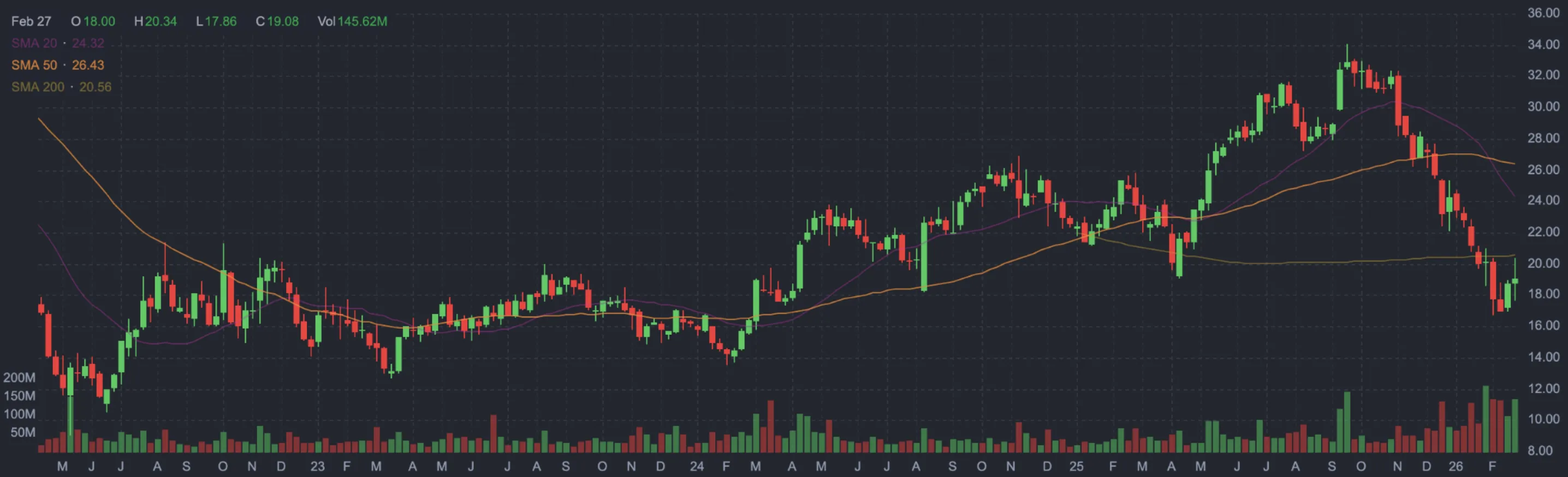
Coupang's price action over the past six months is a textbook distribution-to-accumulation sequence driven by a clearly identified event catalyst. The stock traded above $35 in mid-2025 before the breach became public, declined sharply into the low $20s on initial disclosure, stabilised briefly, then was driven lower by the parliamentary hearing episode and legal filing announcements into the $17–$20 range where it currently sits. Volume patterns during the decline show the progressive exhaustion typical of event-driven selloffs: high-volume panic selling on the news events, followed by lower-volume, orderly drift - the classic signature of retail distribution into institutional accumulation.
The $17–$19 entry zone represents a convergence of technical support factors: a major historical price level from Coupang's post-IPO trading range, a zone of high-volume accumulation in the most recent price data, and an RSI reading on the weekly chart that has reached territory associated with durable bottoms in growth equity selloffs. Importantly, the stock is showing higher lows on the daily chart from its most recent low - an early but notable sign that the supply-demand balance is shifting toward buyers.
Live Price Chart (NYSE: CPNG)
The Trade
The following scenarios reflect the author’s personal analysis and are not investment recommendations. See our full disclaimer.
Core Thesis: Scenario Range for CPNG in the $17–$19 Zone
Coupang at current prices is a high-quality, dominant franchise trading at the valuation of a distressed asset. The data breach is a real but bounded liability in a business that generates over a billion dollars of annual free cash flow and holds five times the worst-case liability in cash. The moat - Rocket Delivery, WOW ecosystem, fulfillment density - is not impaired. Taiwan is growing triple-digits. Smart institutional money is accumulating. The path to $29–$34 runs through regulatory clarity, subscriber stabilisation, and the market's eventual re-rating of a platform it has priced for failure.
Catalyst Timeline - H1 2026 to H1 2027
Execution Guide
- Scenario Entry Range: $17–$19. Build in tranches. Tranche 1 (50%) at $17.50–$18.50 on initial entry. Tranche 2 (30%) at any pullback toward $15.50–$17.00 on broad risk-off or Korea-specific news. Tranche 3 (20%) reserve for a potential flush toward $14–$15 on worst-case regulatory headlines. Note: a Tranche 3 purchase at $14–$15 leaves only $1–$2 of buffer before the $13.00 stop-loss - size this tranche conservatively, only add at the lower end of the range ($14) with strict discipline, and only if the underlying thesis (WOW subscriber trajectory, Korea commerce growth) remains intact at the time of the flush.
- Risk Consideration: This is a moderate-to-high risk position given the active regulatory investigation, emerging market exposure, and KRW/USD currency sensitivity. 3–5% of a diversified portfolio is appropriate. Growth-oriented portfolios may size higher given the 1:2.7 R/R and the institutional validation of the thesis by Norges Bank, RIT Capital, and others.
- Key Monitoring Points: WOW subscriber count (quarterly); Korea Product Commerce revenue growth rate; regulatory fine announcement and quantum; Taiwan revenue trajectory and market share estimates; class action case developments; KRW/USD exchange rate (revenues are KRW-denominated; a weak won compresses USD-reported revenue).
- Upside Scenario Milestones: First exit (25%) at $22–$24 - first significant resistance zone and approximate recovery to pre-breach stabilisation levels. Second exit (40%) at $28–$31 - mid-target zone, where the re-rating from distressed to fair-value is largely complete. Final exit (35%) at $32–$34 - full target zone, reflecting partial growth premium recovery.
- Thesis Invalidation Level: $13.00. A sustained close below $13.00 indicates either a materially worse regulatory outcome than our worst-case model, or structural WOW churn data that invalidates the moat thesis. Below this level the thesis no longer holds the regulatory outlook before re-entering.
- Thesis Invalidation Events: (1) WOW subscriber count falls below 12 million in two consecutive quarters; (2) regulatory authorities announce business suspension proceedings; (3) Taiwan operations are formally discontinued; (4) a second significant data breach occurs before enhanced cybersecurity measures are publicly confirmed. Any of these events warrants immediate exit regardless of price.
Important Disclaimer
This content is for informational and educational purposes only and does not constitute financial advice, investment recommendations, or solicitation to buy or sell any securities. Past performance does not guarantee future results. All investments carry risk, including the possible loss of principal. Coupang, Inc. (NYSE: CPNG) is subject to significant risks including but not limited to: ongoing regulatory investigation in South Korea related to the 2025–2026 data breach; active class action litigation in the United States and South Korea; South Korean regulatory and political risk; currency risk (KRW/USD); competitive risks from Naver and other domestic and regional e-commerce operators; execution risk in Taiwan market development; integration risk from Farfetch and R.Lux luxury operations; and general emerging-market and technology-sector risk. The regulatory fine and consumer compensation estimates in this report are based on publicly available information and analytical models as of February 2026; actual outcomes may differ materially. The revenue and valuation scenarios presented are projections based on independent analysis and should not be regarded as forecasts or guarantees. Institutional holding data sourced from publicly available SEC filings and news reports. Analyst price targets cited are those of the named institutions and do not constitute endorsements of this analysis. Always conduct your own due diligence and consult a qualified financial advisor before making any investment decision.