Something unusual is happening in the copper market, and it has nothing to do with speculation.
At $9,903 per tonne on the LME, copper sits near its five-year highs - yet the industry is having its weakest year of mined supply growth since 2011. The world's second-largest copper mine just suffered an 800,000-tonne mud rush that will take until 2027 to fully recover from. The fifth-largest was hit by catastrophic flooding. Chile's state miner, responsible for nearly 30% of global output, cannot grow because its government keeps raiding its balance sheet. And meanwhile, the forces pulling copper demand higher - electric vehicles, AI data centres, grid modernisation, renewable energy - are accelerating on policy mandates that span decades, not business cycles.
This is not a cyclical squeeze. This is a structural transformation in which the world's most critical industrial metal cannot be produced fast enough to meet the demands of electrification. The question facing markets is not whether copper prices rise from here - it is how high they must go to ration a commodity that has no viable substitute in the applications that matter most.
The Supply Crisis: When the World's Biggest Mines Break
To understand why the copper market has tightened so dramatically in 2025, begin with a single number: 500,000. That is the approximate tonnage of copper production removed from near-term supply by a cascade of mine disruptions that rivals anything the industry has seen in the modern era. These are not marginal operations at the fringes of the cost curve. These are the world's largest and most important copper mines - and they are all in trouble simultaneously.
The combined impact is staggering. Goldman Sachs has slashed global copper supply forecasts, projecting deficits of 160,000 tonnes in 2025 and 200,000 tonnes in 2026 - and these revisions came before accounting for the full Grasberg impact. Mine disruptions have been running above 6% of global production for three consecutive years, according to Wood Mackenzie, highlighting a sustained rise in operational risk that shows no sign of abating.
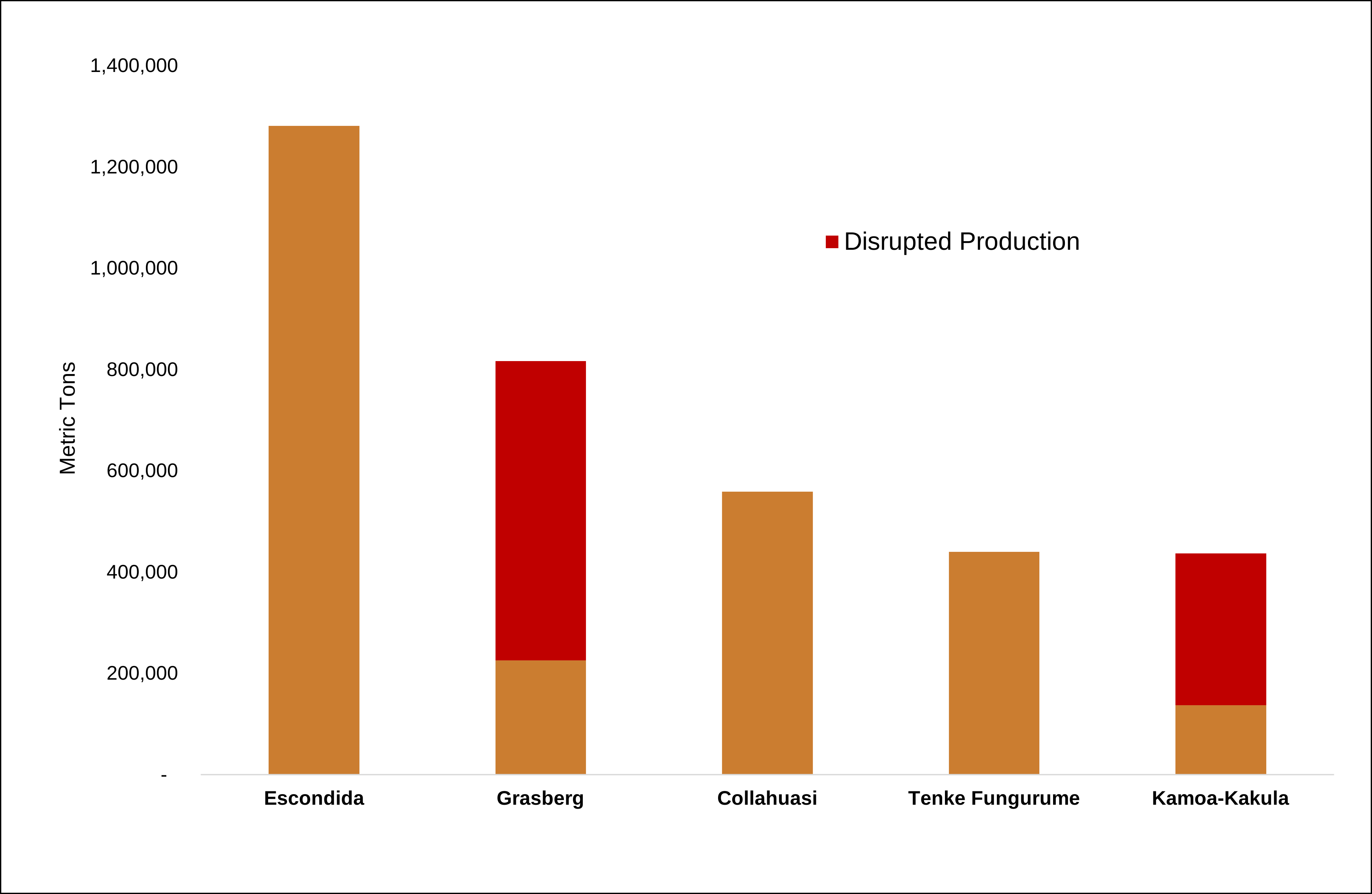
"When you get a mud rush... the damage it does to the electrics, it's just an absolute brute to clear. The fracture dynamics and stress patterns fundamentally change - you can't just pump out the water and resume."
- Merlin Marr-Johnson, Mining Analyst, on Grasberg RecoveryWhat makes 2025 different from previous disruption years is the structural backdrop against which these incidents occur. This is not a market with comfortable inventory buffers absorbing temporary shocks. Years of limited investment in new copper projects, declining ore grades, and lengthening development timelines have steadily eroded the industry's shock-absorption capacity. Any additional disruption - whether from operational setbacks, geopolitical events, or policy changes - now has the potential to drive significant price action precisely because the system has no slack left.
Chile's Copper Conundrum: When the Giant Cannot Grow
Chile produces nearly 30% of the world's copper. Its trajectory over the next decade matters more than any single mine disruption. And the trajectory is troubling.
Codelco, the state-owned mining giant that once symbolised resource nationalism's success, has entered what it diplomatically terms an "optimisation phase." Industry observers recognise the euphemism for what it really is: stagnation. The company's major projects - Chuquicamata Underground and El Teniente expansions - extend mine life but fail to materially increase production capacity. The mathematics are unforgiving: Chile's largest miner cannot grow, yet global demand requires the equivalent of a new major mine every single year.
"It's balance sheet repair. Their funds have regularly been taken out by the government, which means that this company is permanently cash-strapped."
- Merlin Marr-Johnson, on Codelco's Financial ConstraintsThis financial constraint has forced Codelco into pursuing public-private partnerships and joint ventures with Western companies - a dramatic strategic shift. Meanwhile, Chile faces an additional physical constraint that no amount of capital can solve: water scarcity. The Atacama Desert, home to the world's richest copper deposits, faces severe water stress. New projects must incorporate expensive desalination plants, adding hundreds of millions to development costs and years to project timelines.
The block-cave mining technique, once heralded as the solution for accessing deep, low-grade deposits economically, has revealed its Achilles' heel at El Teniente. The discipline required for successful block-cave operations becomes exponentially more difficult in complex geological settings. When disrupted, recovery is not simply a matter of clearing debris. The entire stress pattern of the rock mass changes, potentially requiring complete recalculation of mining plans that took years to develop.
The Electrification Imperative: Demand That Cannot Be Switched Off
While supply struggles dominate headlines, the demand side of the equation presents an equally compelling - and perhaps more permanent - case for structural tightness. Unlike previous copper cycles driven primarily by Chinese construction or infrastructure buildouts, today's demand acceleration stems from government policy mandates with multi-decade deployment timelines. These forces do not reverse during recessions.
GlobalData projects global copper demand growing at a compound annual rate of 3.8% to reach 35.1 million tonnes by 2030. Wood Mackenzie estimates that 7.8 million tonnes of entirely new copper supply will be needed by 2035 just to plug the emerging gap. The International Copper Study Group projects refined usage growth of 2.7% in 2024, accelerating to 3% in 2025 - roughly 500,000 tonnes of additional demand annually, equivalent to the entire output of a major mine.
Energy Transition Demand by Sector
The numbers tell a story of structural transformation. Energy transition copper consumption is growing at a CAGR of 11.2% - nearly eight times faster than traditional industrial demand at 1.4%. Electric vehicles alone, consuming copper at a 13.7% CAGR, represent 55% of total energy transition demand. Each battery electric vehicle contains approximately 83 kg of copper versus 23 kg in a conventional car - a 3.6× multiplier that operates across the entire automotive production chain, from vehicle manufacturing to charging network deployment.
The artificial intelligence revolution has emerged as an unexpected accelerant. Each hyperscale data centre can consume as much copper as a small town's entire electrical grid. Microsoft's recent $80 billion AI infrastructure commitment signals just the beginning. Goldman Sachs estimates that AI-driven data centre expansion could triple copper demand from hyperscale infrastructure by 2030. Offshore wind installations require approximately 15 tonnes of copper per megawatt; solar installations about 12 tonnes per MW. With China alone adding 300 gigawatts of renewable capacity in 2024, the copper intensity of the energy transition is becoming impossible to ignore.
The United Nations itself has weighed in. In May 2025, the UN Trade and Development body estimated that meeting projected copper demand would require $250 billion in investment and at least 80 new mining projects. For context, the entire global copper mining industry produces from roughly 200 major operations today.
What's Breaking vs. What's Building
Supply Under Stress
- Ore grades declining - from ~1.0% in 2000 to ~0.6% in 2025; S&P Global forecasts a further 25% decline this decade
- Development timelines lengthening - from 7–10 years historically to 12–16 years today for greenfield projects
- Smelter margins collapsing - spot TC/RCs fell below $5/t in mid-2024 vs. $50–$100 historical average; Chinese smelter utilisation dropped to 82–85%
- Water constraints intensifying - 60–90 m³ per tonne in the world's driest copper region
- Weakest supply growth since 2011 - mine output projected at just 2.1% growth to 23.4 Mt in 2025
- $100 billion capex gap - required investment over the next decade shows no signs of materialising
Demand Accelerating
- Global demand CAGR 3.8% - to 35.1 Mt by 2030, driven by urbanisation, electrification, and AI
- EV sales 14 million units in 2023 (18% of passenger cars), each requiring 3.6× more copper
- AI data centres - could triple hyperscale copper demand by 2030 (Goldman Sachs)
- China 54% of global demand - structural floor from grid modernisation and EV production
- India & SE Asia - population growth and industrialisation adding demand layer beyond China
- Policy mandates - IEA net-zero pathway requires copper demand to double from current levels
Five-Year Performance: Copper's Decoupling
The most revealing chart in the copper market today is not a supply-demand balance. It is a simple price overlay showing copper against iron ore and oil over the past five years. While the latter two remain tethered to China's property cycle and OPEC dynamics respectively, copper has broken away - driven by forces that transcend any single economy or cartel decision.
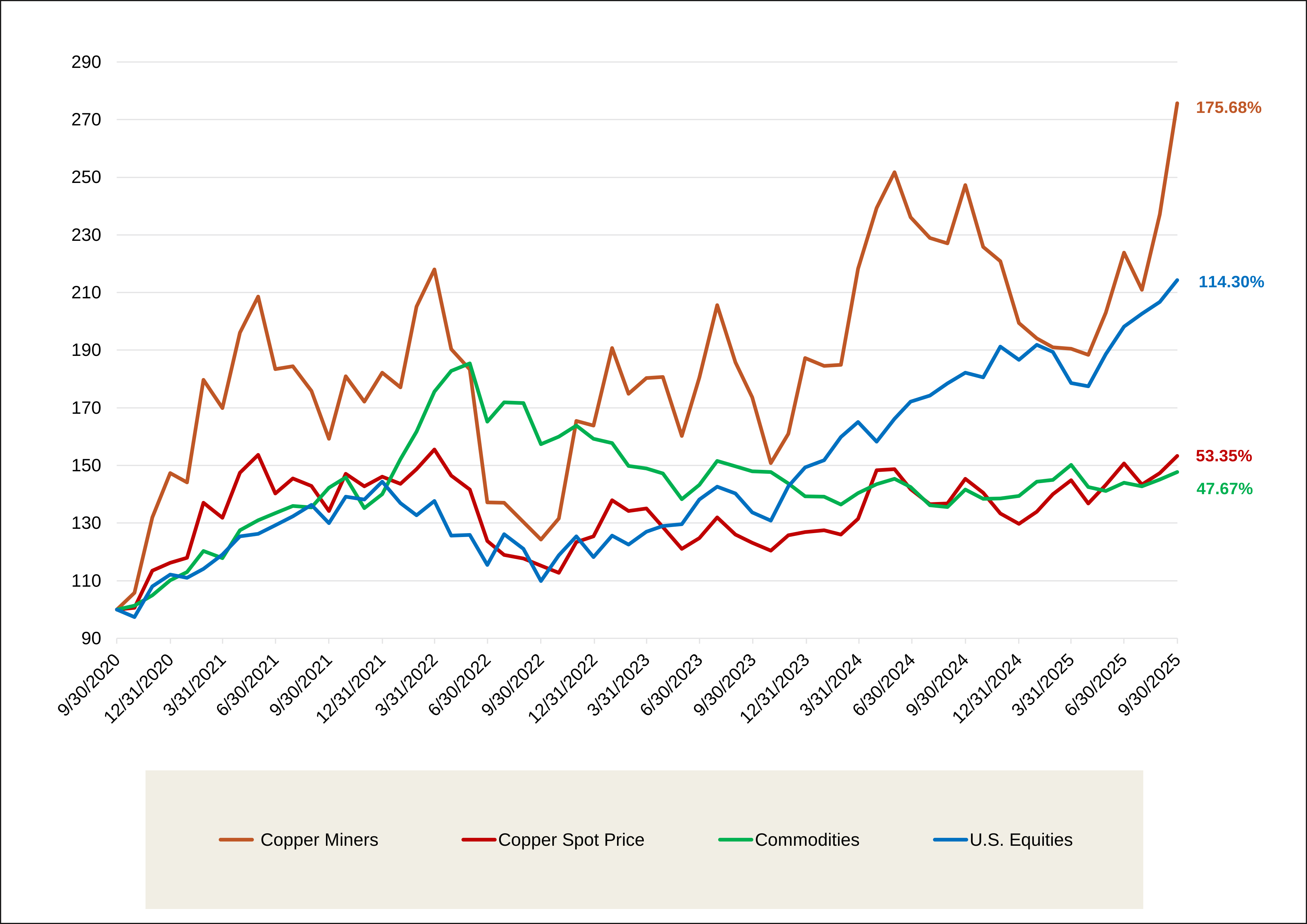
The performance data through September 30, 2025 tells the story. Copper miners, measured by the Nasdaq Sprott Copper Miners Index, have returned 38.3% year-to-date - more than double the S&P 500's 14.8% and vastly outpacing the Bloomberg Commodity Index's 5.9%. Junior copper miners have been the standout, surging 72.5% YTD, reflecting the market's appetite for leveraged exposure to a commodity it increasingly views as structurally undersupplied.
Over five years, the picture is even more dramatic. Copper miners have compounded at 22.5% annualised versus 16.5% for U.S. equities and 8.1% for broad commodities. The copper spot price itself has returned 8.9% annualised, outperforming both commodities broadly and keeping pace with equities - remarkable for a physical commodity with no yield.
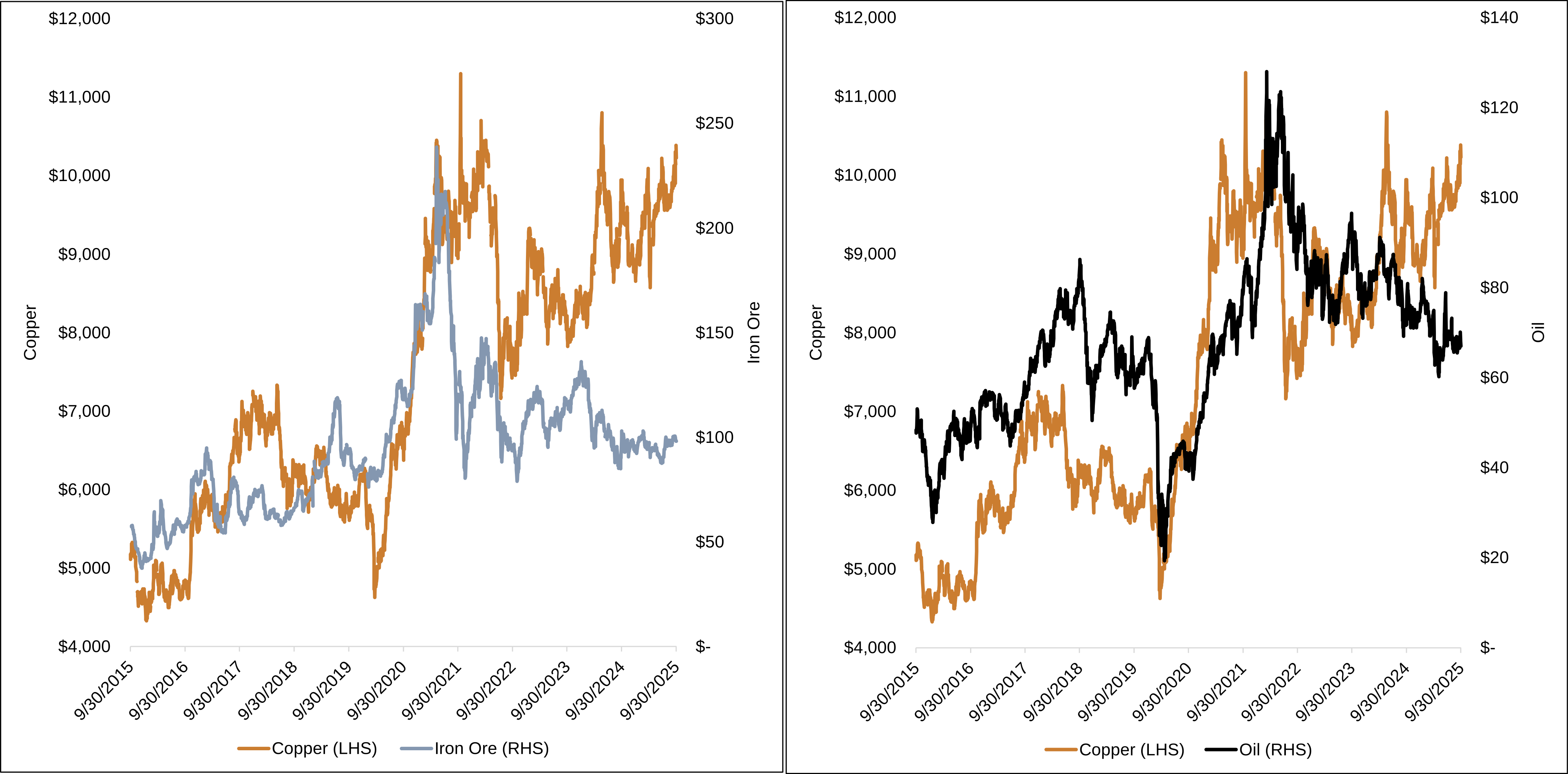
This decoupling is not temporary. Iron ore and coal have historically relied on Chinese urbanisation and now face structurally declining demand. Copper, by contrast, stands at the intersection of every major global priority: energy security, defence modernisation, technological advancement, and climate transition. As Kenny Ives, chief commercial officer at CMOC and potential CEO candidate for Glencore, put it: he is "nice and bullish on copper prospects," predicting prices could reach $12,000 per tonne before the end of 2025.
Billion-Dollar Bets: The M&A Wave and What It Signals
When the world's largest mining companies - organisations with multi-billion-dollar exploration budgets and decades of geological expertise - choose to buy copper reserves rather than discover them, it tells you something profound about the state of supply. The M&A wave sweeping the copper sector is not about financial engineering. It is an admission that organic supply growth cannot meet the market's needs.
| Transaction | Year | Value | Premium |
|---|---|---|---|
| Anglo American + Teck Resources merger | 2025 | $53 billion combined | 17% |
| Lundin acquires Filo Mining | 2024 | C$4.1B (US$3.0B) | 32.2% |
| BHP acquires Oz Minerals | 2023 | A$9.6B (US$6.8B) | 49.3% |
| Rio Tinto acquires Turquoise Hill | 2022 | $3.3B (remaining 49%) | 67% |
| Orion Resource Partners invests in Capstone Copper | 2025 | $360 million | Asset-level |
The Anglo American-Teck Resources merger stands as the definitive statement of copper's strategic primacy. At a combined $53 billion, the deal creates the world's sixth-largest copper producer - and could ramp up to operate the world's largest copper mine. Teck's simultaneous spin-off of its coal business makes the strategic logic unmistakable: legacy commodities are being shed to concentrate on the one metal that every major miner views as essential to their future.
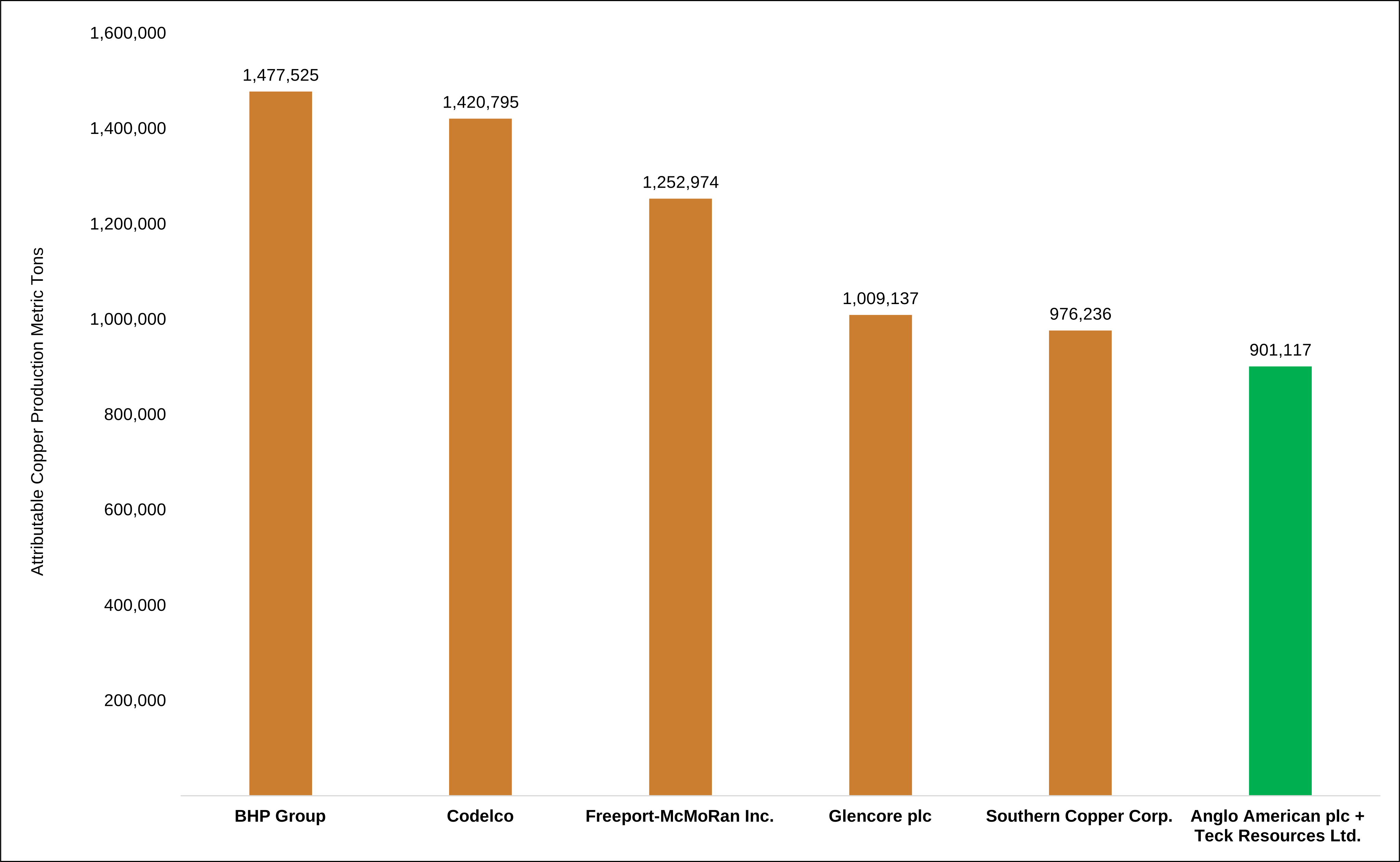
Anglo American itself demonstrated the strategic value of its copper portfolio by successfully fending off a takeover bid from BHP - the world's largest copper producer - whose interest was driven almost entirely by Anglo's copper assets. In the wake of that defence, Anglo spun off its platinum business as Valterra Platinum and sold its coal and nickel operations. The message from every corner of the industry is the same: copper is the metal of the future, and there is not enough of it.
Orion Resource Partners' $360 million investment in Capstone Copper's Santo Domingo project, valuing the asset at $1.4 billion with contingent payments tied to specific resource milestones, reveals how sophisticated institutional capital is positioning. These are not speculative bets. They are carefully structured investments in de-risked, near-production assets by investors who see the supply gap as a multi-year structural reality.
Washington's New Playbook: When Governments Buy Equity in Miners
Perhaps the most underappreciated development in the copper market is the emergence of the U.S. government as a direct equity investor in mining companies. This is not subsidies or tax breaks - it is the federal government taking ownership stakes, a level of strategic commitment that signals copper has moved from commodity to national security asset.
In September 2025, the Trump administration took a direct 10% equity stake plus warrants in Trilogy Metals (TMQ), valued at $35.6 million, while simultaneously issuing an executive order permitting construction of the Ambler Access Road in Alaska. TMQ shares tripled on the news. The Ambler Road, a long-contested infrastructure project, is designed to unlock vast critical mineral deposits - a clear signal that permitting reform and domestic resource security have become executive-level priorities.
The pattern extends beyond copper. The administration secured equity in Lithium Americas (LAC) tied to renegotiating the Thacker Pass DOE loan - LAC's share price nearly doubled in a single day. The Department of Defense became the largest shareholder in MP Materials via a $400 million preferred equity package that included a price floor commitment for rare earths set well above spot prices. For copper miners, especially U.S.-focused juniors, the implications are profound: accelerated permitting, streamlined regulatory hurdles, and increased likelihood of reaching production milestones are now tangible realities backed by government capital.
Why New Supply Cannot Fill the Gap
In theory, high prices solve supply shortages. In practice, the copper industry faces constraints that price alone cannot overcome - at least not within the timeframes that matter.
The timeline from discovery to production has stretched from an average of 7 years in the 1970s to over 16 years today. This means that even if every promising copper deposit in the world received development approval tomorrow, meaningful new supply would not reach the market until the late 2030s. The industry requires approximately $100 billion in new development capital over the next decade - investment that, as of late 2025, shows no signs of materialising at the pace required.
The recycling wildcard offers partial relief but not salvation. Copper is infinitely recyclable, and high prices do incentivise scrap collection. However, most of the world's copper stock is locked in long-lived infrastructure - buildings, power grids, industrial equipment - with useful lives of 30–50 years. Technical limitations mean scrap cannot fully offset primary supply shortfalls: only Type 1 scrap is directly usable, while lower-quality material requires additional refining capacity that is itself constrained. As Wood Mackenzie noted at the LME Forum 2025: recycling will help, but it will not be sufficient to plug the deficit.
Meanwhile, the smelting bottleneck compounds the mining challenge. Global copper smelting capacity reached approximately 27.8 million tonnes in 2023, with China accounting for roughly 50%. But treatment charges - the fees smelters earn for processing concentrate - have collapsed to historic lows. Benchmark annual TCs settled at $80 per tonne, while spot rates briefly traded below $5 per tonne against historical averages of $50–$100. Chinese smelter operating rates fell to 82–85% in mid-2024, down from typical utilisation above 90%. Several smelters, including Aurubis (Europe's largest), have implemented production cuts. The industry faces a two-front war: not enough copper coming out of the ground, and not enough capacity to process what does.
Price Outlook: Three Paths Through the Decade
The copper market stands at what many veterans call the early stages of a commodity supercycle. But unlike previous cycles driven by Chinese urbanisation or monetary expansion, this one stems from structural transformations in how humanity produces and consumes energy. Institutional forecasters are converging around a view of persistent elevated prices, though they disagree on how high the ceiling extends.
Conservative
Moderate global growth, stable supply conditions, successful recycling expansion. China economic slowdown dampens industrial demand, partially offset by energy transition consumption floor. Substitution pressures emerge in price-sensitive applications.
Base Case
Continued deficits and steady demand growth from electrification. Supply disruptions persist at elevated rates. M&A consolidation accelerates but does not add net new supply. Bank of America and Goldman Sachs cite this range as their central forecast through 2026.
Accelerated Deficit
Major supply shocks on top of existing disruptions. Faster energy transition adoption driven by policy mandates. AI data centre buildout exceeds forecasts. Chinese economic stimulus adds demand layer. Industry leaders like CMOC's Kenny Ives target $12,000/t before year-end 2025.
Morgan Stanley projects copper deficits expanding from 590,000 tonnes in 2026 to 1.1 million tonnes by 2029 - the most severe structural shortage in over two decades. Goldman Sachs' AI infrastructure analysis suggests that data centre expansion alone could add significant upside to baseline demand forecasts. Institutional price targets for 2027–2028 range from $13,000–$15,000 per tonne under base-case scenarios, with potential to reach $18,000+ under severe shortage conditions.
The forward curve tells its own story. LME copper futures exhibit persistent backwardation - near-term contracts trading above longer-dated ones - a pattern that typically emerges only during genuine physical shortage conditions, not financial-driven speculation.
Catalyst Roadmap
The Bear Case: What Could Go Wrong
Intellectual honesty demands acknowledging the risks, even in a market with powerful structural tailwinds.
China remains the elephant in the room. Consuming over 54% of global copper production, any meaningful slowdown in Chinese economic growth could temporarily overwhelm supply-side dynamics. However, China's pivot toward high-technology manufacturing and renewable energy infrastructure suggests copper demand may prove more resilient than during previous downturns. The 74.7% Asia-Pacific share of global consumption means this region's trajectory is the single most important variable in the near term.
Substitution is real but limited. Aluminium can replace copper in some electrical applications, though with efficiency penalties. At current price ratios, substitution remains economically unattractive for most uses. But sustained prices above $15,000 per tonne could change that calculus in marginal applications like low-voltage wiring and heat exchangers. More broadly, the demand forecasts underpinning the structural bull case assume electrification continues on its current trajectory - an assumption worth scrutinising. Aluminium substitution has historically compressed copper demand during price spikes, particularly in power cables and certain EV motor windings where performance penalties are tolerable. And a meaningful slowdown in China's property and infrastructure cycle represents the most material near-term demand risk of all: China accounts for roughly half of global copper consumption, and any demand growth shortfall there would not simply dent the thesis - it would delay it by years.
Trade policy adds uncertainty. Trump administration tariffs have not only raised domestic prices and shifted global trade flows but are actively deterring long-term copper investment, according to Wood Mackenzie. The tension between wanting domestic supply security and implementing policies that discourage capital deployment creates a policy contradiction that the market has not yet resolved.
Resource nationalism is evolving. Chile's proposed mining royalty reforms, Peru's community relations challenges, and the DRC's shifting fiscal regime all threaten to reduce investment attractiveness precisely when capital deployment should accelerate. The risk is no longer coups and nationalisations - it is regulatory creep that makes projects uneconomic at the margin.
The Structural Case: Why This Time Is Different
Every commodity analyst is trained to distrust the phrase "this time is different." It is usually wrong. But the copper market in late 2025 presents a genuinely unusual configuration of forces.
On the supply side: the world's largest mines are breaking, Chile's giant cannot grow, ore grades are declining, development timelines have doubled, smelters are losing money, and the industry needs $100 billion in capital that is not being deployed. On the demand side: electrification mandates spanning EVs, grid modernisation, AI infrastructure, and renewable energy are creating consumption growth that operates on policy timelines, not business cycles - and the UN itself says 80 new mines are needed.
Copper has already decoupled from iron ore and oil, the two commodities that defined the last supercycle. It has outperformed equities and broad commodities over one, three, and five-year horizons. Major miners are spending tens of billions on acquisitions rather than exploration - an implicit admission that they cannot find and develop new supply fast enough. And the U.S. government is taking direct equity stakes in mining companies, elevating copper from commodity to strategic asset.
The question is not whether the structural deficit is real. The deficit is visible in the data, confirmed by institutional forecasters, and priced into a forward curve showing persistent backwardation. The question is how long it persists and how high prices must rise to incentivise the supply response the world desperately needs. With 12–16 years between discovery and production, the answer to that question may already be determined: the supply that will matter in 2030 needed to be approved years ago. It was not.
For the copper market, the clock is not ticking forward toward resolution. It is ticking forward toward intensification.
For investors, the structural case is most compelling over a 3-7 year horizon for those who can tolerate the cyclical price volatility that has historically accompanied commodity supercycles - copper can fall 30-40% on growth scares even within a multi-year bull market. Pure-play miners such as Freeport-McMoRan and Ivanhoe Mines offer the most direct leverage to the supply deficit thesis, since their earnings respond asymmetrically to copper price moves. That said, entry timing matters: speculative futures positioning can push copper well above its fundamental clearing price in the near term, creating expensive entry points even when the long-term thesis is sound. Monitoring LME exchange inventory levels and net speculative positioning in the futures market - both publicly available through weekly CFTC commitment-of-traders reports - provides a practical framework for identifying periods when the market has already priced in optimism, and when genuine physical tightness is driving price rather than momentum.
Key Takeaways
- Over 500,000 tonnes of copper production have been removed from near-term supply by disruptions at Grasberg, Kamoa-Kakula, El Teniente, Quebrada Blanca, and Cobre Panamá - the most severe cascade of mine failures in recent history
- Global copper demand is projected to grow at 3.8% CAGR to 35.1 Mt by 2030, with 7.8 Mt of entirely new supply needed by 2035 (Wood Mackenzie)
- Energy transition sectors are growing copper demand at 11.2% CAGR versus 1.4% for traditional industry - EVs, AI data centres, and renewables create a consumption floor that persists through economic downturns
- Mine development timelines have stretched to 12–16 years, ore grades have fallen from 1.0% to 0.6%, and smelter treatment charges have collapsed - supply constraints operate at every level of the production chain
- The Anglo-Teck $53B merger and wave of high-premium acquisitions signal that major miners view organic supply growth as insufficient, choosing to buy reserves rather than discover them
- Copper has decoupled from iron ore and oil, outperforming both over five years - copper miners returned 38.3% YTD and juniors 72.5%, reflecting structural rather than cyclical positioning
- The U.S. government is taking direct equity stakes in mining companies, elevating copper from commodity status to national security asset with accelerated permitting implications
- Base-case price forecasts centre on $10,000–$12,000/t through 2026 with institutional targets of $13,000–$15,000 by 2027–2028; persistent LME backwardation confirms genuine physical tightness
PolyMarket Investment, Research Team, November 6, 2025